
MANUFACTURING CYBERSECURITY RESEARCH
Manufacturing Cybersecurity Research: What 1,625 Findings Reveal
Accent Consulting analyzed 1,625 anonymized cybersecurity findings from 21 manufacturing organizations. The research identifies six recurring risk areas that can affect production, sensitive data, business operations and resilience.
21
Organizations Assessed
6
Core Risk Areas Identified
1,625
Findings
Analyzed
4
Years Of
Research
What Does the Research Show?
Accent Consulting’s manufacturing cybersecurity research found six recurring risk areas: identity and access, patch management, encryption, external exposure, remote access, and cloud security.
These risks often overlap. For example, a compromised account may provide access to a remote connection, while an unpatched system may expose a production environment. As a result, manufacturers can use these findings to identify their most important gaps and decide where to begin.
In addition, the research shows that cybersecurity issues can affect more than technology. They may also affect production, business operations, sensitive data and long-term resilience.
Manufacturing Cybersecurity Risks Are Connected
Manufacturing environments combine legacy systems, production technology, remote vendor access, cloud services, and connected equipment. Together, these systems help manufacturers operate efficiently. However, they also create more points to monitor and protect.
In addition, common challenges include outdated systems, weak access controls, exposed internet-facing services, inconsistent patching, limited visibility, and poorly managed remote connections.
For example, an outdated system may create a path into a production environment. At the same time, weak access controls may allow an attacker to move between connected systems.
Therefore, manufacturers should review cyber risk as a connected business issue rather than treat each weakness as a separate problem.
Six Core Manufacturing Cybersecurity Risks
Accent Consulting grouped the research findings into six connected risk areas. Together, these stories provide a broader view of manufacturing cybersecurity.
First, explore the topic that best matches your current environment. Then, review the other areas to understand how the risks may connect.
1
Identity & Access
Shared accounts, weak MFA, and excessive permissions can increase access risk.
2
Patch Management
Unsupported systems and unpatched vulnerabilities can increase exposure.
3
Encryption
Sensitive data needs protection during storage, use and transmission.
4
External Exposure
Internet-facing systems and vendor connections can create entry points.
5
Remote Access
Remote connections need strong controls, monitoring and regular review.
6
Cloud Security
Cloud systems need clear access controls, monitoring and secure configuration.
Manufacturing Cybersecurity Risks Are Connected
Manufacturing environments combine legacy systems, production technology, remote vendor access, cloud services, and connected equipment. Together, these systems help manufacturers operate efficiently. However, they also create more points to monitor and protect.
For example, an outdated system may create a path into a production environment. At the same time, weak access controls may allow an attacker to move between connected systems.
These risks often affect one another. For instance, a compromised account may provide access to a remote connection, while an unpatched system may increase the impact of a network intrusion.
Therefore, manufacturers should review cyber risk as a connected business issue rather than treat each weakness as a separate problem.
Six Core Manufacturing Cybersecurity Risks
Accent Consulting grouped the research findings into six connected risk areas. Together, these stories provide a broader view of manufacturing cybersecurity.
First, explore the topic that best matches your current environment. Then, review the other areas to understand how the risks may connect.
1
Identity
Shared accounts, weak MFA, and excessive permissions can increase access risk.
2
Patching
Unsupported systems and unpatched vulnerabilities can increase exposure.
3
Encryption
Sensitive data needs protection during storage, use, and transmission.
4
Externl Exposure
Internet-facing systems and vendor connections can create entry points.
5
Remote Access
Remote connections need strong controls, monitoring, and regular review.
6
Cloud Security
Cloud systems need clear access controls, monitoring, and secure configuration.
ABOUT THE RESEARCH
Built From Real-World Manufacturing Assessments
This original research is based on 1,625 anonymized cybersecurity findings identified through assessments of 21 manufacturing organizations between 2023 and 2026. Accent Consulting used Galactic Scan to support the identification and documentation of findings. Afterward, the Accent Consulting team reviewed and analyzed the results to identify recurring manufacturing cybersecurity risks.
Next, Accent Consulting grouped the findings into six areas: identity and access, patch management, encryption, external exposure, remote access, and cloud security. Because the organizations operated in different environments, the findings show recurring patterns rather than representing every manufacturer.
SOURCE
Findings came from cybersecurity assessments of 21 manufacturing organizations.
SCOPE
Assessments considered technology, processes, users, access, vulnerabilities, and network controls.
ANALYSIS
Accent Consulting reviewed and grouped the findings into six recurring risk areas.
PRIVACY
Organizations were anonymized, and the findings do not identify individual companies.
Source: Accent Consulting analysis of anonymized findings from 21 manufacturing organizations.
SUPPORTING INDIANA MANUFACTURES
Helping Indiana Manufacturers Navigate Cyber Risk
Accent Consulting supports Indiana manufacturers through its work with the Indiana Manufacturers Association. Through this work, the company helps manufacturing leaders understand technology, cybersecurity, and operational risks in real-world environments.
In addition, sharing these findings with the manufacturing community helps leaders move from awareness to action. The goal is to connect industry-specific risks with practical steps for reducing exposure and improving resilience.
As a result, manufacturers can use the research to start better conversations about cybersecurity priorities, operational needs, and long-term improvement.
Explore Accent Consulting’s manufacturing services and industry experience to learn how Accent Consulting supports manufacturing organizations, or review our broader cybersecurity services for help evaluating and reducing risk.

SUPPORTING INDIANA MANUFACTURES
Helping Indiana Manufacturers Navigate Cyber Risk
Accent Consulting supports Indiana manufacturers through its work with the Indiana Manufacturers Association. This partnership reflects a commitment to helping manufacturing leaders understand technology, cybersecurity and operational risks in real-world environments.

By sharing these findings with the manufacturing community, Accent Consulting helps leaders move from awareness to action. The goal is to connect industry-specific risks with practical steps for reducing exposure and improving resilience.
Explore our manufacturing services and industry experience to learn how Accent Consulting supports manufacturing organizations, or review our broader cybersecurity services for help evaluating and reducing risk.
USING THIS RESEARCH HUB
Navigate the Manufacturing Cybersecurity Findings
Use the research to identify the risks most relevant to your environment, review related findings, explore practical guidance and prioritize your next steps
Start with the area that best matches your current environment, or review all six risk areas to build a broader view of manufacturing cybersecurity priorities.
HOW TO USE THIS HUB
Turn the research into a practical next step.
Use the research to identify the risks most relevant to your environment, review the related findings, explore practical guidance, and prioritize your next steps.
Start with the area that best matches your current environment, or review all six risk areas to build a broader view of manufacturing cybersecurity priorities.
THE MANUFACTURING CYBER RISK LANDSCAPE
What Are the Biggest Cybersecurity Challenges Facing Manufactures?
Manufacturing environments combine legacy systems, production technology, remote vendor access, cloud services, and connected equipment. Together, these systems help manufacturers operate efficiently. However, they also create more points to monitor and protect.
In addition, common challenges include outdated systems, weak access controls, exposed internet-facing services, inconsistent patching, limited visibility, and poorly managed remote connections. For example, an outdated system may create a path into a production environment. Similarly, an exposed network service may give an attacker an entry point.
These risks often overlap. For instance, a compromised account may provide access to a remote connection, while an unpatched system may expose a production environment. Therefore, manufacturers should review these risks together rather than treat each issue as completely separate.
Accent Consulting’s manufacturing cybersecurity services help organizations evaluate exposure, strengthen controls and build practical plans for improving resilience.
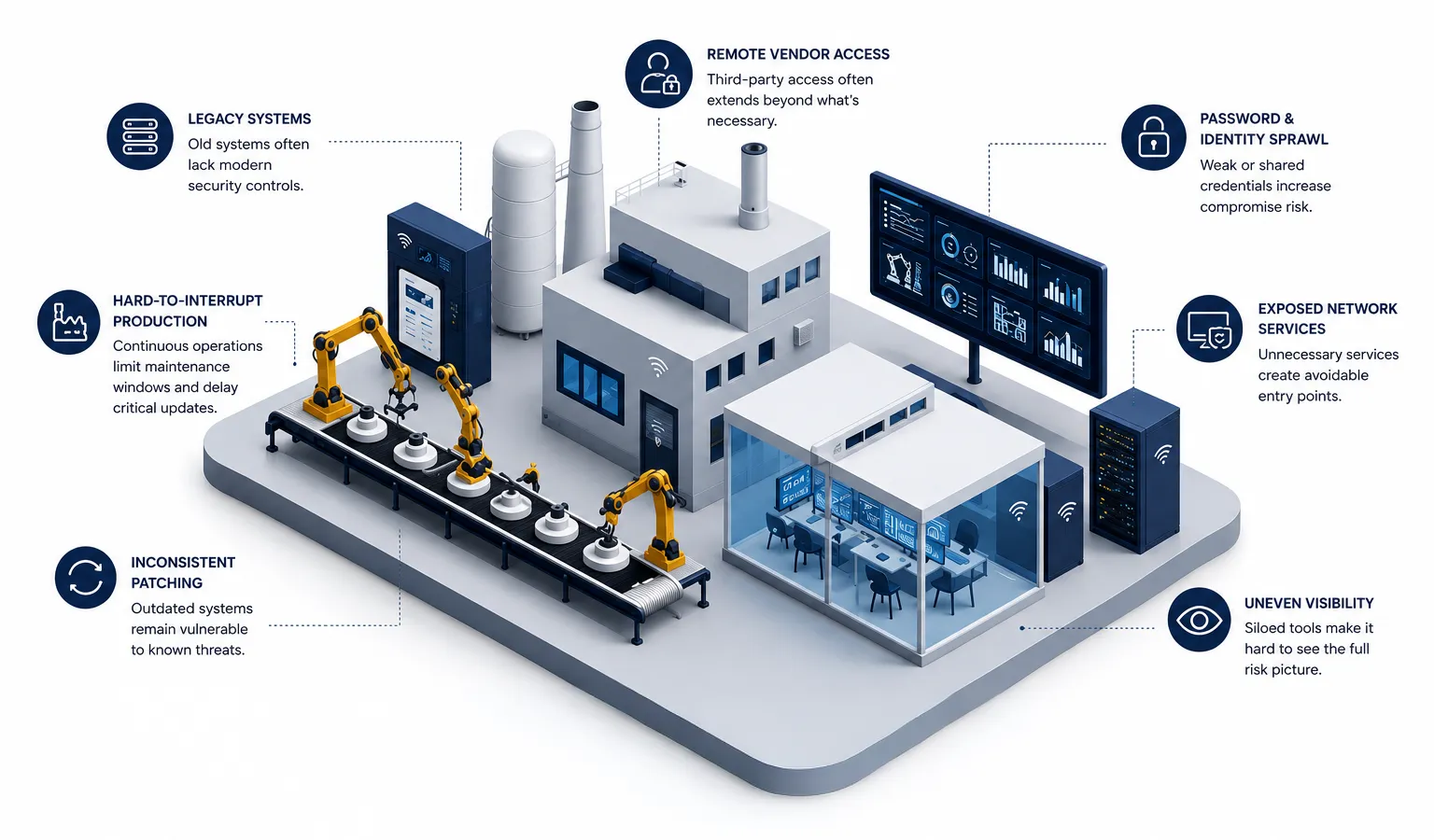
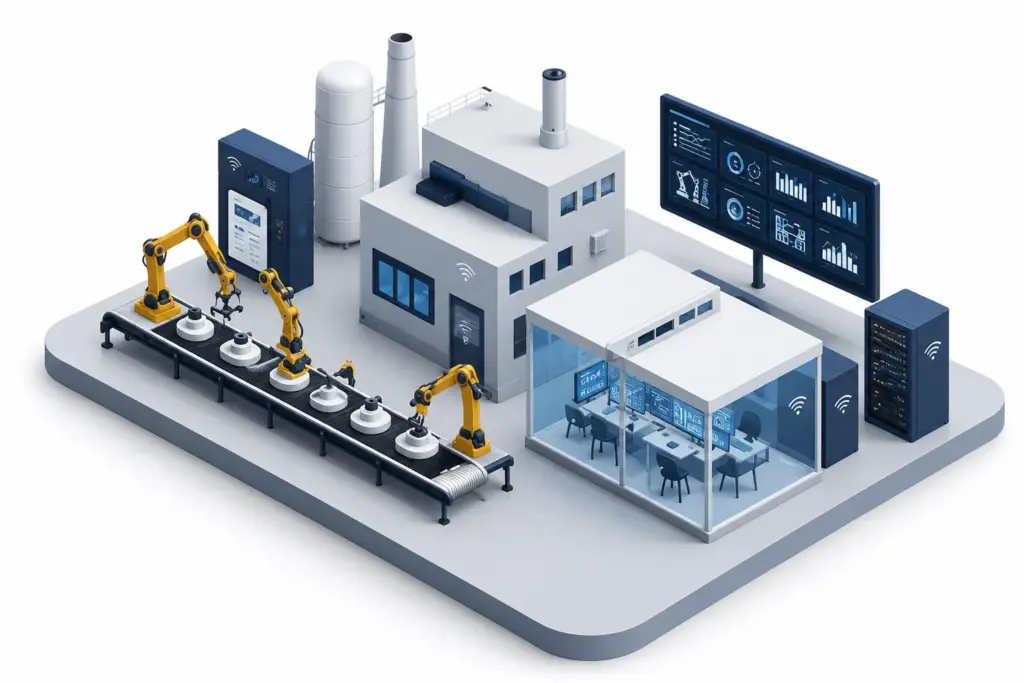
The manufacturing cyber risk landscape includes identity, patching, remote access, external exposure, cloud security, and visibility challenges.
The Six Core Cyber Risk Stories
The research findings are organized into six focused stories. Each story explains why the risk matters in manufacturing, what the research revealed, and which actions can help reduce exposure. Together, these pages provide a practical starting point for reviewing manufacturing cybersecurity risk.

Identity and Access
Shared credentials and inconsistent access controls can make compromise easier. Review privileged access, passwords, MFA and account lifecycle controls regularly.

Patch Management
Inconsistent patching can leave known vulnerabilities exposed. Prioritize critical assets, document exceptions, and formalize review cycles.

Encryption
Sensitive data is not always protected consistently across environments. Review data classification, encryption coverage and key-management practices.

External Exposure
Exposed services can create avoidable entry points. Reduce unnecessary exposure, require strong authentication and control external access.

Remote Access
Poorly governed remote access can expand the attack path. Audit vendor access, apply least-privilege controls and monitor remote connections.

Cloud Security
Cloud weaknesses can create trusted access paths into sensitive business data and workflows. Strengthen identity, configuration and monitoring controls.
Although each topic has its own page, the risks can affect one another. For that reason, manufacturers may need to review several areas at the same time.
WHAT GOOD LOOKS LIKE
What Higher-Maturity Manufacturers Do Differently
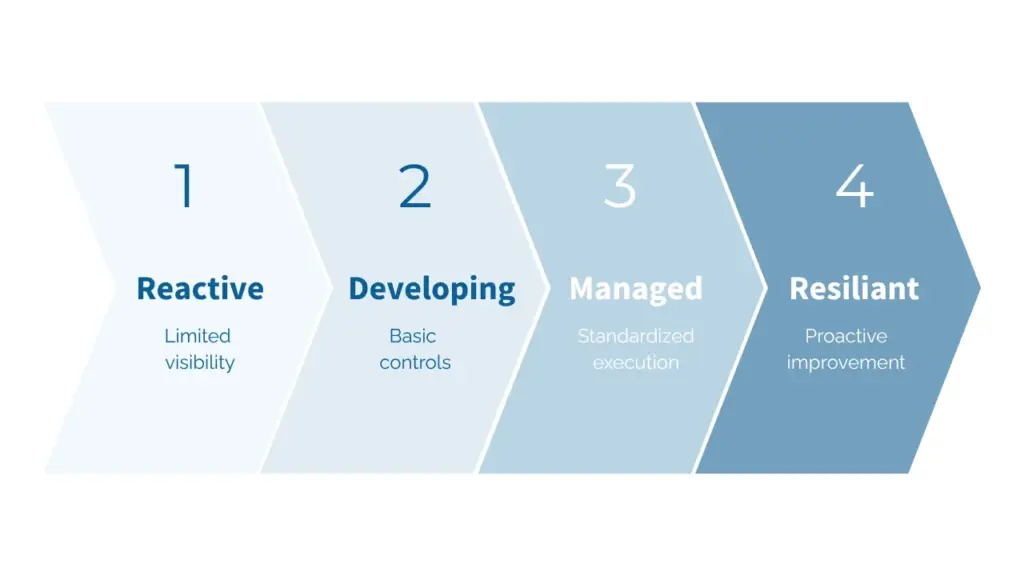
High-maturity manufacturers treat cybersecurity as an ongoing business process rather than a one-time project. Instead, they regularly review people, systems, facilities, and third-party access while aligning security work with operational priorities.
As a result, these organizations improve visibility into assets and access. They also review permissions, address vulnerabilities, monitor remote connections, and test whether their controls work as expected.
In addition, mature manufacturers connect cybersecurity decisions to production needs, business continuity, safety, and resilience. In this way, security becomes part of regular operations instead of a response to the latest incident.
Finally, this research can help manufacturing leaders compare recurring risk patterns and decide where improvement should begin. It is a guide for prioritization, not a formal maturity rating for an individual organization. Therefore, leaders should use the findings as a starting point for discussion and assessment.
WHAT GOOD LOOKS LIKE
Higher-Maturity Manufacturers Do Things Differently.
High-maturity manufacturers treat cybersecurity as an ongoing business process rather than a one-time project. Instead, they regularly review people, systems, facilities, and third-party access while aligning security work with operational priorities.
As a result, these organizations improve visibility into assets and access. They also review permissions, address vulnerabilities, monitor remote connections, and test whether their controls work as expected.
In addition, mature manufacturers connect cybersecurity decisions to production needs, business continuity, safety, and resilience. In this way, security becomes part of regular operations instead of a response to the latest incident.
Finally, this research can help manufacturing leaders compare recurring risk patterns and decide where improvement should begin. It is a guide for prioritization, not a formal maturity rating for an individual organization.
WHAT GOOD LOOKS LIKE
Common Manufacturing Cybersecurity Questions
What cybersecurity practices matter most for manufacturers?
Manufacturers should focus first on identity and access controls, patch management, remote access, vulnerability management, encryption, cloud security, and visibility into critical systems. The right priorities depend on the organization’s systems, operations, risk exposure, and business goals. A cybersecurity assessment can help identify which improvements should come first.
Why is ransomware a major concern in manufacturing?
Ransomware can interrupt production, affect business systems, delay shipments, and expose sensitive information. Strong identity controls, reliable backups, network segmentation, patching, and tested response plans can reduce the impact of an attack.
How should manufacturers prioritize cybersecurity investments?
Begin with the systems and access points that could cause the greatest operational harm. Review production systems, privileged accounts, remote connections, internet-facing services, and critical data. Then rank improvements by risk, business impact, and ease of implementation. This approach helps leaders focus resources where they can make the greatest difference.
What makes manufacturing cybersecurity different from general IT security?
Manufacturing cybersecurity must protect business systems as well as production technology, connected equipment, engineering systems, vendors, and plant operations. Security improvements must also account for uptime, safety, system availability, and operational constraints. A control that works well in a traditional office environment may need a different approach on a production floor.
How can manufacturers improve cyber resilience?
Manufacturers can improve resilience by reducing unnecessary access, patching critical systems, securing remote connections, segmenting networks, protecting backups, monitoring important assets, and testing response plans. Leaders should review these controls regularly and update them as systems, vendors, and business needs change.
READY FOR THE NEXT STEP?
Turn these insights into an actionable roadmap.
The research can help identify the risks most relevant to your environment. Every manufacturer has different systems, operational constraints, and priorities.
Accent Consulting can help evaluate your current cybersecurity posture, understand where exposure is concentrated, and build a practical roadmap for improvement.
QUESTIONS LEADERS ARE ASKING
Common Manufacturing Cybersecurity Questions
What cybersecurity practices matter most for manufacturers?
Manufacturers should prioritize identity and access controls, vulnerability and patch management, remote and third-party access, asset visibility, incident response, backup recovery, and protection of operational technology environments. The right priorities depend on the organization’s critical assets, production requirements, and current risk profile.
Why is ransomware a major concern in manufacturing?
Ransomware can interrupt production, impact operational continuity, delay fulfillment, and create recovery pressure across both IT and connected operational environments.
How should manufacturers prioritize cybersecurity investments?
Start by identifying critical assets and business processes. Then prioritize risks based on operational impact, likelihood, exploitability, existing controls, and the organization’s ability to detect, respond to, and recover from an incident. A cybersecurity assessment can help identify where improvement should begin.
What makes manufacturing cybersecurity different from general IT security?
Manufacturing cybersecurity must account for production uptime, operational technology, legacy systems, safety requirements, plant-floor environments, vendors, contractors, and the potential physical consequences of a cyber incident. Accent Consulting’s manufacturing industry expertise reflects these operational realities.
How can manufacturers improve cyber resilience?
Manufacturers can improve resilience by strengthening identity controls, improving asset and vulnerability visibility, securing remote access, testing recovery procedures, segmenting critical environments, and establishing clear incident response responsibilities. Accent’s cybersecurity services can help evaluate these priorities in context.
READY FOR THE NEXT STEP?
Turn these insights into an actionable roadmap.
The research can help you identify the risks most relevant to your environment, but every manufacturer has different systems, operational constraints, and priorities.
Work with Accent Consulting to evaluate your current cybersecurity posture, understand where exposure is concentrated, and build a practical roadmap for improvement.