
MANUFACTURING CYBERSECURITY RESEARCH
The Cloud Trust Problem: Why Microsoft 365 Access Needs Stronger Governance
Microsoft 365 supports communication, collaboration and daily manufacturing operations. However, weak authentication, excessive privileges and poorly governed accounts can turn legitimate access into a pathway for compromise. Accent Consulting reviewed 1,625 anonymized cybersecurity findings from 21 manufacturing organizations between 2023 and 2026. The assessment identified recurring concerns involving Microsoft 365 identity controls, administrative access and cloud account governance.
What is Cloud Security in Manufacturing?
Cloud security in manufacturing refers to the policies, controls and oversight used to protect cloud-based systems, identities, data and administrative access.
Manufacturers rely on cloud platforms for communication, file sharing, collaboration, productivity tools and business applications. In many environments, those platforms also connect to vendors, remote workers, distributed teams and other business systems.
That makes cloud security more than a technology issue. It affects how manufacturers control access, protect sensitive information and manage trust across connected users and services.
Why Does Cloud Security Matter in Manufacturing?
Cloud security matters because cloud platforms often hold business-critical data and provide trusted access to everyday operations.
A compromised cloud account may expose email, files, internal communications, financial records or administrative tools. Risk increases when organizations allow weak authentication, excessive permissions, stale accounts or poorly governed integrations.
For that reason, manufacturers should treat cloud identity and access as a security boundary. Each account, role and integration should have a clear purpose, appropriate controls and a regular review process.
What Microsoft 365 Access Risk Looks Like in Manufacturing
Microsoft 365 is now part of everyday manufacturing operations. It supports communication, file sharing, collaboration and administrative workflows across plants, offices and distributed teams. Leadership depends on it to keep information moving quickly between people, systems and locations.
That makes Microsoft 365 an important security boundary, but the platform itself is not the problem. Risk develops when identity and access controls are not administered with the same discipline manufacturers apply to other critical systems.
Across the manufacturers reviewed, Accent Consulting found recurring issues involving authentication, administrative privileges, account lifecycle management and trusted cloud access. On their own, those conditions may appear manageable. Together, they can create trusted pathways into email, files and connected business systems.
21
Manufacturers
Assessed
5
Environments with Significant M365 Identity Findings
7
Admin Account
Compromise Issues
4
Cloud Access Control Themes Identified
Source: Accent Consulting analysis of 1,625 anonymized cybersecurity findings from assessments of 21 manufacturing organizations conducted between 2023 and 2026.
CLOUD IDENTITY GOVERNANCE
Why Microsoft 365 Needs Stronger Access Governance
Manufacturers often assume cloud platforms are secure because they are hosted, familiar and widely used. However, cloud security still depends on local decisions about authentication, privileged access and account governance.
When those controls are weak, Microsoft 365 becomes more than an email system. It becomes a trusted access layer connected to business data, employee communications and administrative workflows.
That is why Microsoft 365 should be treated as a governed security function, not just a collaboration tool. Stronger manufacturers apply consistent control over who can sign in, who has elevated access, which users face additional verification and how account activity is reviewed over time. They also use clear policies to reduce unnecessary access and respond quickly when suspicious behavior appears.
This level of oversight helps reduce risk and supports a more resilient manufacturing environment. It also helps manufacturers protect productivity by limiting disruptions before they grow into larger operational problems.
WHAT THE FINDING REVEALED
How Identity and Access Builds Over Time
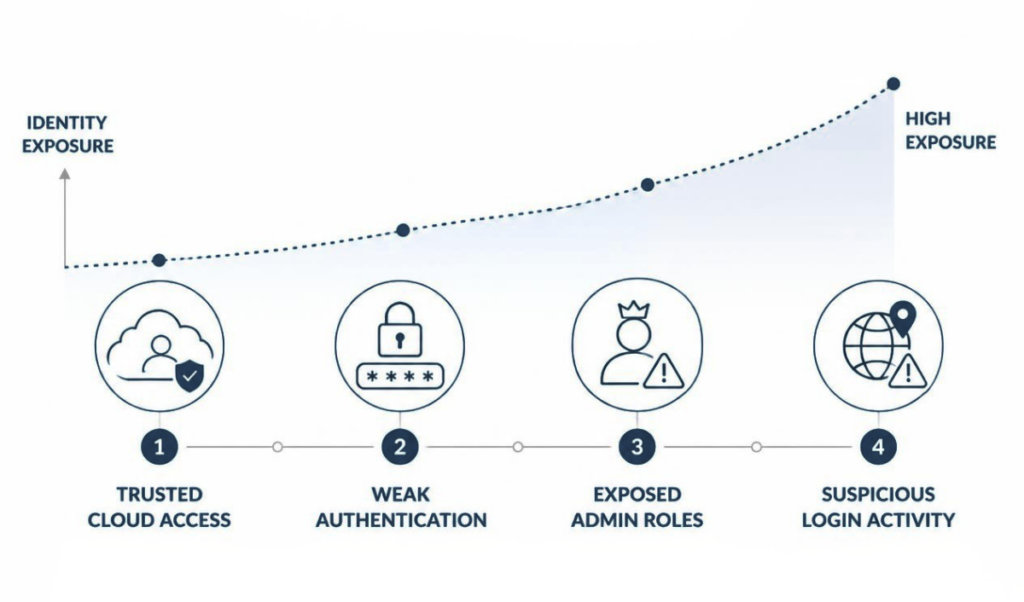
The findings showed a recurring pattern: cloud identity risk often grows gradually. In several environments, Microsoft 365 access was affected by incomplete multifactor authentication, unnecessary administrative privileges, elevated accounts with passwords that did not expire and cloud access relationships that increased exposure.
None of those conditions means Microsoft 365 is insecure. Instead, they reflect the way administrators manage identity, access and trust around the platform.
Over time, those decisions can compound. An account with weak authentication becomes more consequential when it also has elevated privileges. A legitimate cloud integration becomes harder to monitor when it can access sensitive information. A dormant account becomes more significant when nobody realizes it is still active.
What begins as administrative convenience can gradually become unnecessary trust, and unnecessary trust creates opportunity for attackers.
Four Microsoft 365 Issues That Increase Cloud Access Risk
Microsoft 365 access risk often develops through a small number of repeated identity and governance issues. Weak MFA can make account compromise easier. Excessive administrative privileges can expand the impact of a single account. Older active accounts may remain available longer than intended. Trusted cloud access relationships can also create persistent paths that are difficult to see or control.
Taken together, these conditions show why manufacturers should review Microsoft 365 access as part of a broader cybersecurity program. The issue is not whether Microsoft 365 is secure. The issue is whether access to it is governed well enough to protect business information, employee communications and connected workflows.
WHERE CLOUD IDENTITY RISK SHOWS UP
The Most Common Microsoft 365 Control Issues
Cloud identity exposure often follows a small number of repeated patterns. Multifactor authentication may be incomplete or inconsistently enforced, while privileged accounts retain more access than they need. Older accounts may also remain active longer than they should.
In higher-risk cases, users may face greater likelihood of account compromise or data exposure without enough compensating controls in place.
These issues matter because Microsoft 365 does not operate in isolation. It supports the same communications, documents and coordination manufacturers rely on every day.
These issues matter because Microsoft 365 does not operate in isolation. It supports the same communications, documents and coordination manufacturers rely on every day.
WHAT WE FOUND
How Trusted Access Becomes Exposure
The findings pointed to a consistent pattern in how Microsoft 365 identity risk takes shape. In some environments, access conditions created a higher likelihood of account compromise or increased the potential impact if an account were compromised.
Administrator accounts remained too lightly protected in some cases, increasing the likelihood of misuse or unauthorized access. The data also showed that multifactor authentication was not always applied as consistently as it should be across users and privileged accounts. Taken together, these conditions can increase the chance that trusted cloud accounts are used to reach files, communications and other sensitive business information.
The lesson is not that manufacturers should avoid Microsoft 365. It is that they need to closely govern who and what they trust.
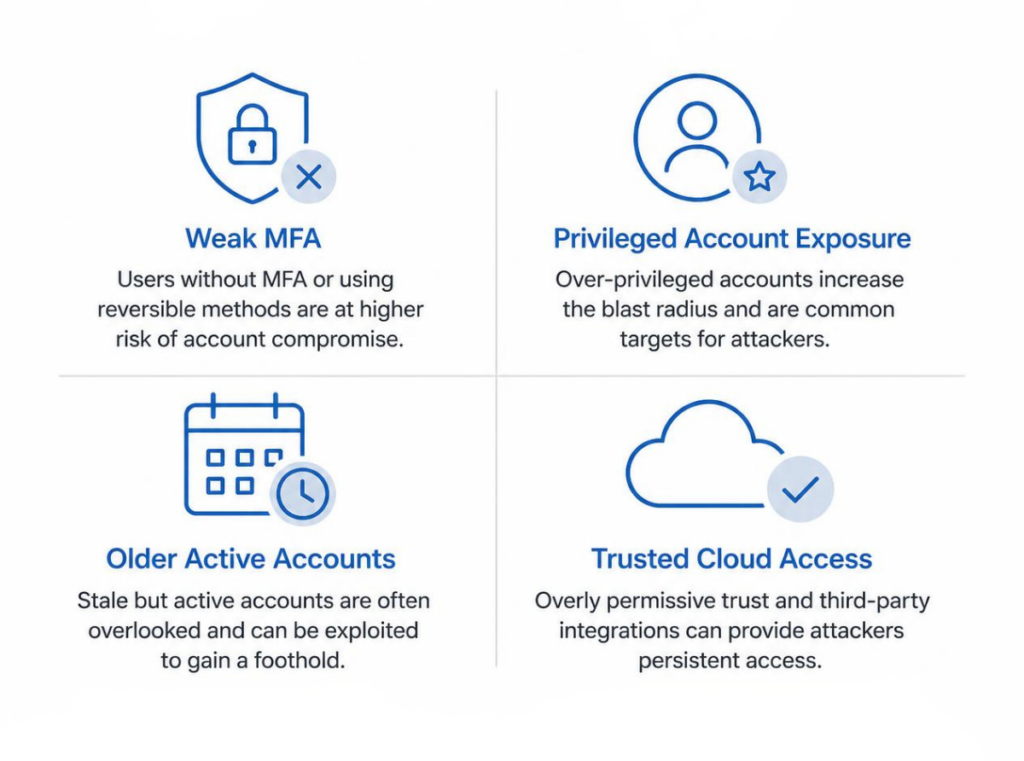
Four Conditions That Increase Microsoft 365 Risk
Microsoft 365 risk often appears through a small number of repeated access and governance issues. Weak MFA can make account compromise easier. Over-privileged accounts can expand the impact of misuse. Older active accounts can remain available longer than intended. Trusted cloud access can also create persistent pathways that are difficult to monitor.
Together, these conditions show why manufacturers should review cloud identity controls as part of a broader cybersecurity program.
COMMON QUESTIONS
How Manufacturers Can Secure Microsoft 365 Access
Why does Microsoft 365 access matter in manufacturing?
Microsoft 365 supports communication, file sharing and administrative work across plants, offices and distributed teams. Because it connects important users and information, weak access controls can create a path into sensitive business systems and data.
How can manufacturers reduce Microsoft 365 account risk?
Manufacturers can reduce Microsoft 365 account risk by requiring MFA, limiting administrative privileges, reviewing older accounts and monitoring sign-in activity more closely. Stronger policies around account access and lifecycle management can also reduce unnecessary trust.
Which Microsoft 365 accounts should manufacturers review first?
Manufacturers should start with administrator accounts, older active accounts, shared or unclear account ownership and accounts connected to trusted cloud integrations. These accounts often create the greatest risk because they can provide broader access or remain active longer than expected.
Why can trusted Microsoft 365 access still become a security risk?
Trusted access can become a security risk when organizations assume approved accounts or cloud relationships do not need close review. If authentication is weak or permissions are too broad, a trusted account can become an easy path to email, files and administrative systems.
What did the Microsoft 365 findings show?
The findings showed recurring issues involving inconsistent MFA, unnecessary privileges, older active accounts and trusted cloud access relationships that increased exposure. These conditions do not mean Microsoft 365 is insecure, but they do show why manufacturers need stronger cloud identity governance.
WHAT LEADERS SHOULD DO NEXT
Build a more secure cloud access model.
Improve MFA coverage, tighten administrative controls and address weakly protected accounts before they become entry points.