
MANUFACTURING CYBERSECURITY RESEARCH
The Encryption Gap: Why Manufacturing Data Is More Exposed Than Leaders Realize
Manufacturing data can become exposed when sensitive information moves across unencrypted devices, removable media, cloud systems, wireless networks, and connected business applications. Accent Consulting analyzed 1,625 anonymized cybersecurity findings from 21 manufacturing organizations between 2023 and 2026. The research identifies recurring encryption and data-protection gaps that can affect confidentiality, business operations, and regulatory readiness.
What Is Data Encryption in Manufacturing?
Manufacturing data encryption protects information by changing it into a form that unauthorized people cannot easily read. Encryption can protect data when it is stored on a device, sent across a network, or shared between systems.
In manufacturing, encryption may protect engineering files, production records, customer information, financial data, employee records, passwords, cloud data, removable drives, and wireless connections.
Why Does Encryption Matter in Manufacturing?
Encryption can reduce the impact of lost devices, unauthorized access, and intercepted data. However, encryption is only one part of data protection. Manufacturers should also use access controls, strong passwords, MFA, system monitoring, backups, and secure settings.
Why Manufacturing Data Exposure Often Starts Quietly
Manufacturing leaders often think about cyber risk in terms of ransomware, downtime, or major attacks. However, data exposure can start with a smaller issue.
For example, a laptop may not be encrypted. A cloud folder may be shared with too many people. A removable drive may contain engineering files. Also, a wireless network may send data without enough protection.
Each issue may seem limited on its own. However, the result may be the same: sensitive information could remain easy to read outside its intended system.
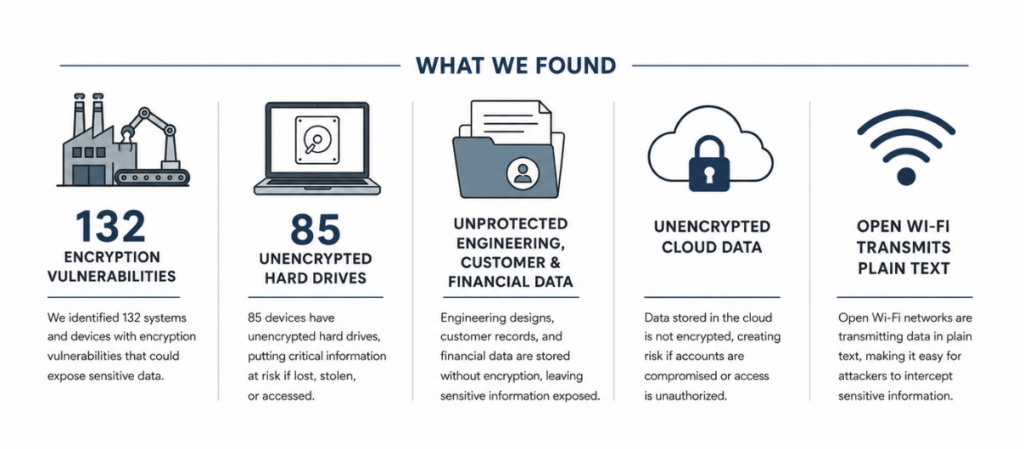
Accent Consulting analyzed 1,625 anonymized cybersecurity findings from 21 manufacturing organizations. The research found 132 encryption-related findings and 85 unencrypted hard drives.
These findings do not mean that an attacker stole or accessed the data. Instead, they show that some data may not have had the level of protection expected in the assessed environments.
For manufacturers, the concern is more than a technical problem. Engineering files, process details, pricing information, customer data, employee records, and business information can all affect the value and strength of the company. Explore the full manufacturing cybersecurity research to review the other risk areas.
21
manufacturing organizations assessed.
8%
of identified findings were encryption-related.
132
encryption-related findings identified.
85
unencrypted hard drives identified.
Source: Accent Consulting analysis of 1,625 anonymized cybersecurity findings from assessments of 21 manufacturing organizations conducted between 2023 and 2026.
OPERATIONAL IMPACT
How Encryption Gaps Can Affect Manufacturing Operations
Manufacturing data can exist on laptops, servers, cloud systems, removable drives, wireless networks, production systems, and business applications.
Because data moves through many places, its protection may not be the same everywhere.
For example, a lost laptop or removable drive may contain readable engineering files, customer records, financial information, or employee data. In the same way, a cloud folder with weak settings may allow people to view information they do not need.
The impact may go beyond data privacy. Exposed information can affect company secrets, production work, customer trust, business advantage, and legal or contract needs.
For that reason, manufacturers should review encryption along with identity security, access controls, cloud settings, remote access, and data-retention rules.
KEY FINDINGS
What the Encryption Findings Reveal
The findings point to a broader pattern: sensitive data may exist across many ordinary systems and environments.
The research identified encryption-related findings involving hard drives, cloud storage, engineering information, customer data, financial information, and wireless communications.
For example, an unencrypted hard drive may contain information that remains readable if the device is lost or removed from service. Similarly, an improperly protected cloud repository may expose information to users who do not need access.
The risk depends on the type of data, where it is stored, who can reach it, and whether encryption protects it during storage and transmission.
Therefore, manufacturers should identify where sensitive data exists, classify its importance, and confirm that appropriate encryption and access controls are in place.
BUSINESS IMPACT
Business Impact of Stronger Data Protection
Strong data-protection practices can reduce the likelihood and impact of unauthorized disclosure. They may also help manufacturers:
- protect engineering files and intellectual property;
- reduce exposure from lost or retired hardware;
- protect customer and employee information;
- limit the impact of credential theft;
- support privacy, contractual, and regulatory obligations; and
- improve confidence in business continuity and operational resilience.
The source material also points to broader business consequences when encryption is missing. These may include intellectual-property exposure, legal or regulatory concerns, customer trust issues, insurance implications, and delays in responding to an incident.
However, encryption does not stop every type of unauthorized access. It should work with strong passwords and MFA, limited access, secure settings, system monitoring, and response plans.
RISK LOCATIONS
Where the Encryption Gap Appears
Encryption gaps can appear in everyday systems and workflows. These may include endpoint devices, shared cloud repositories, removable media, wireless networks, production systems, and business applications.
Accent Consulting’s findings point to three common exposure areas:
- Unencrypted hard drives: 85 unprotected drives contained engineering files, customer data and financial records.
- Cloud storage without encryption: Personally identifiable information, including employee and customer records, was stored in cloud environments without enough protection.
- Plaintext data on open Wi-Fi: Information transmitted over open wireless networks was visible to anyone on the network.
Each issue creates a similar business concern: sensitive manufacturing information may remain readable outside its intended controls.
Manufacturers should therefore review where sensitive data is stored, how it moves between systems, and which users or devices can access it.
Where the Encryption Gap Appears
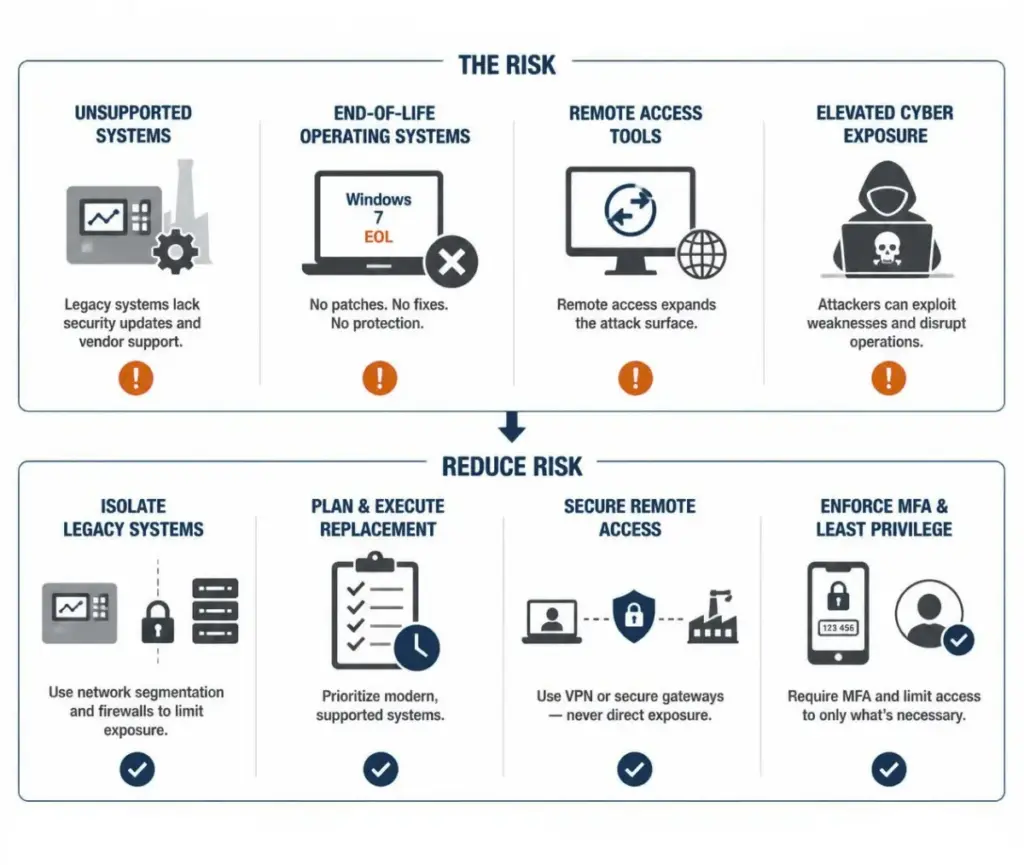
Encryption is most effective when it works with system isolation, access control, secure configuration and regular review. Together, these controls reduce the chance that sensitive data remains broadly accessible.
COMMON QUESTIONS
What You Can Do Next
How do we prevent data exposure in manufacturing environments?
Start by identifying sensitive data and documenting where it is stored, used, and transmitted. Next, review encryption for endpoints, servers, databases, cloud platforms, removable media, and wireless networks. Manufacturers should also use MFA, least-privilege access, secure configurations, network segmentation, monitoring, and documented data-retention practices. Together, these controls help reduce the chance that sensitive data remains readable or broadly accessible.
How do you know if our IT infrastructure is leaving data exposed?
Review asset inventories, cloud repositories, endpoint configurations, wireless networks, remote-access tools, storage devices, and access permissions. Look for unencrypted drives, overly broad cloud permissions, unsupported systems, open wireless networks, unnecessary remote access, and sensitive data stored without appropriate protection. A cybersecurity assessment can help identify gaps that internal teams may not see through routine operations.
Why does full-disk encryption matter in manufacturing?
Full-disk encryption helps protect data stored on laptops, workstations, removable devices, and other supported endpoints if a device is lost, stolen, retired, or accessed without authorization. However, full-disk encryption does not replace access controls or network protections. Manufacturers should also protect data in transit, secure cloud systems, manage permissions, and monitor access to sensitive information.
How can manufacturers protect data in cloud storage?
Manufacturers should identify sensitive data stored in cloud platforms, apply appropriate encryption, restrict access, use MFA, review sharing settings, and monitor administrative activity. They should also confirm how cloud providers handle encryption keys, backups, logging, retention, and data removal.
What does encryption mean for manufacturing leaders?
Encryption is a business-protection control, not only a technical setting. It can help protect engineering information, customer data, employee records, financial information, and operational knowledge. Leaders should ask where sensitive data exists, who can access it, how it moves, whether encryption protects it, and what happens when systems or devices are retired.
LEADERSHIP NEXT STEPS
Take control of your data protection strategy.
Start by identifying sensitive data, reviewing encryption coverage, and closing the gaps that leave information exposed.
Accent Consulting can help your organization evaluate data-protection risks, validate encryption coverage, and build a practical roadmap for improving security.