
MANUFACTURING CYBERSECURITY RESEARCH
Remote Access in Manufacturing: How External Connections Expand Cyber Risk
For many manufacturers, remote access supports equipment maintenance, vendor service, and distributed operations. However, weak authentication, too many remote-access tools, and limited session monitoring can create hidden paths into manufacturing systems. Accent Consulting reviewed 1,625 anonymized cybersecurity findings from 21 manufacturing organizations between 2023 and 2026. The research identified recurring remote-access risks that may affect system security, production support, and business operations.
What Is Remote Access in Manufacturing?
Remote access allows users to connect to systems from another location. Manufacturers use it to troubleshoot equipment, support vendors, maintain systems and keep operations moving.
For example, a technician may connect to a production system without visiting the facility. A vendor may also use remote access to update equipment or resolve a service issue.
These connections can support uptime and reduce delays. However, each connection also creates a possible path into the environment. Manufacturers should know who can connect, which tools they use, what systems they can reach and when access should end.
Why Does Remote Access Matter in Manufacturing.
Remote access matters because it connects outside users, vendors, and support teams to internal manufacturing systems.
These connections may reach business applications, engineering tools, production environments and sensitive data. As a result, a weakness in a remote-access tool or account may affect more than one system.
Risk increases when manufacturers use outdated software, weak passwords, shared accounts, broad permissions or limited session monitoring. Vendor access may also remain active after maintenance work ends.
For that reason, manufacturers should treat every remote connection as a security boundary. Each connection should have a clear business purpose, approved users, strong authentication, limited permissions, monitoring and a regular review date.
Why Remote Access Risk Often Starts Quietly
Remote-access risk usually grows over time. A team may add one tool for equipment support, another for a vendor and a third for emergency maintenance.
At first, each tool may solve a real business need. Over time, however, the organization may lose track of which tools remain active, who owns them and which systems they can reach.
Old software, shared accounts, weak login controls and limited session records can make the problem harder to see. In addition, teams may leave vendor access open after a project ends.
As these small gaps build, remote access can become difficult to manage. A tool that once helped the business may eventually create an unnecessary path into the environment.
21
manufacturing organizations assessed.
3-5
remote access tools found across environments.
4
recurring remote-access risk themes identified.
4
practical steps recommended to reduce remote risk.
ASSESSMENT INSIGHTS
Remote Access Patterns Across Manufacturing
Accent Consulting assessed 21 manufacturing organizations and found recurring concerns across remote-access environments.
The organizations used between three and five remote-access tools. The assessment also identified four recurring risk themes and four practical steps that can help reduce remote-access risk.
These results describe the assessed organizations. They do not represent every manufacturer and they do not prove that an attack occurred.
Even so, the patterns show why manufacturers should manage remote access as part of a formal cybersecurity program. Organizations need to know which tools they use, who can access them, how teams monitor sessions and when they should remove access.
ACCESS CONTROL
Why Remote Connections Need Clear Ownership
Manufacturers need remote access to support uptime, maintain equipment and troubleshoot systems. However, constant access does not mean that every user needs access at all times.
A stronger approach starts with clear ownership. Each remote-access tool should have a responsible owner, approved users, defined permissions and a regular review schedule.
Manufacturers should also require strong authentication and monitor remote sessions. When a vendor needs access for a specific task, the organization should limit that access to the required systems and remove it when the work ends.
Remote access should not depend on informal habits or undocumented exceptions. Instead, manufacturers should manage each connection as part of a security process that supports both operations and risk control.
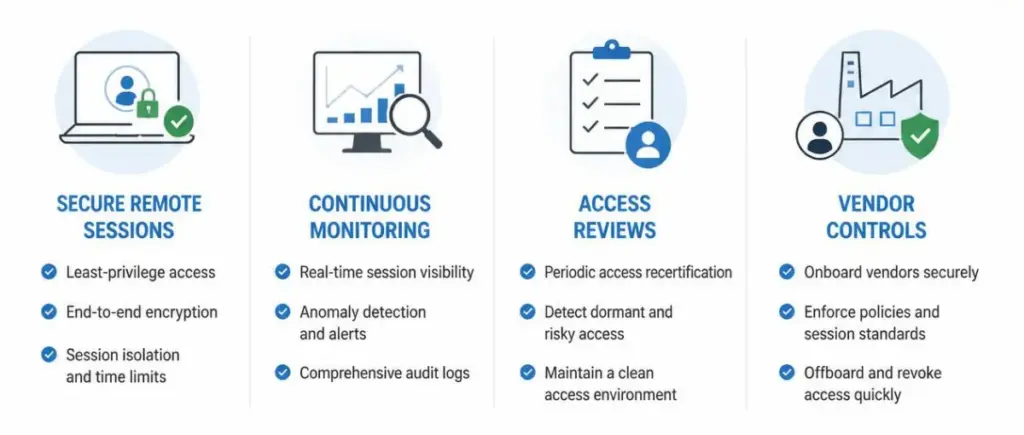
Four Controls That Reduce Remote-Access Risk
Manufacturers can reduce remote-access risk by securing sessions, monitoring activity, reviewing access and managing vendors. Secure sessions limit what users can do. Monitoring helps teams identify unusual activity. Regular access reviews remove permissions that users no longer need. Vendor controls help ensure that outside organizations follow the same security expectations as internal teams. Together, these controls help manufacturers support remote work without creating unnecessary paths into the environment.
WHERE REMOTE RISK SHOWS UP
The Most Common Remote-Access Gaps
Remote-access risk often appears when organizations use too many tools, rely on outdated software or provide access without strong controls.
Tool sprawl makes oversight harder because each platform may use different login rules, settings and logs. Outdated software may also contain weaknesses that attackers can exploit.
Weak authentication creates another concern. Shared accounts, reused passwords and missing MFA make it harder to confirm who is connecting. Limited logging creates a similar problem because teams may not be able to reconstruct what happened during a session.
Vendor access also requires close attention. Vendors may need remote connections to maintain equipment, but manufacturers should limit those connections by time, system, role and business need.
WHAT MANUFACTURERS SHOULD DO NEXT
How to Reduce Remote-Access Risk
Manufacturers can reduce remote-access risk by creating a clear process for approving, using and reviewing remote connections.
First, organizations should choose approved remote-access tools and remove platforms that no longer serve a business purpose. Next, they should require MFA, use named accounts and limit permissions based on each user’s job.
Vendor access should follow the same process. Manufacturers should define which systems a vendor can reach, set an end date, monitor the connection and remove access when the work ends.
Finally, teams should review remote access on a regular schedule. They should also review access after staff changes, system updates, maintenance work and vendor changes.
This process gives manufacturers better control over who connects, what they can reach and how the organization responds when something changes.
How Remote Access Can Create an Attack Path
A remote connection may begin with a legitimate business need. However, the risk increases when the connection uses weak authentication, broad permissions or outdated software. An outside user may connect through a remote-access tool. From there, the connection may reach a workstation, server, engineering system or production-connected device. MFA, limited permissions, session monitoring and network separation can reduce that risk. In addition, manufacturers should review each connection and remove access when the business need ends.
Example remote-access path showing an outside user connecting through a remote-access tool to internal manufacturing systems protected by MFA, limited permissions, monitoring and network segmentation.
COMMON QUESTIONS
How Manufacturers Can Secure Remote Access
Why is remote access important for manufacturing operations?
Remote access helps manufacturers troubleshoot equipment, support vendors and maintain systems without waiting for someone to arrive on site. However, each connection can create a path into the environment. Manufacturers should protect remote access with strong authentication, limited permissions, approved tools and session monitoring.
How can manufacturers secure vendor remote access?
Manufacturers should give vendors access only to the systems they need and only for as long as they need it. Each vendor connection should use MFA, a named account, limited permissions and a clear end date. In addition, manufacturers should monitor the session and remove access when the work ends.
How can we tell who is using remote access?
Manufacturers should use named accounts and keep clear records of remote sessions. These records should show who connected, which system they accessed, when the session started and when it ended. Shared accounts make this process harder. Therefore, manufacturers should avoid shared credentials and review remote-access logs on a regular schedule.
How many remote-access tools should a manufacturer use?
Manufacturers should use as few remote-access tools as possible while still supporting business and production needs. Using too many tools makes it harder to manage passwords, updates, permissions and session logs. A smaller set of approved tools can improve visibility and make security reviews easier.
What should manufacturers do when they cannot remove remote access?
When manufacturers cannot remove remote access, they should reduce the risk around it. Teams should require MFA, limit user permissions, restrict vendor connections, update the remote-access software, monitor sessions and place the system behind secure network controls. Manufacturers should also document why the connection remains open and review that decision regularly.
WHAT IT MEANS
Treat Remote Access as a Security Boundary
Reduce remote-access risk by using approved tools, securing vendor connections, limiting permissions and monitoring each session.
Accent Consulting can help your organization review remote-access tools, identify control gaps and create a practical plan to protect manufacturing systems.