

What Does Managed IT Include? A Complete Guide to Managed IT Services and MSP Contracts

Published: July 27, 2026

Technology plays a central role in nearly every modern business. From email and cloud platforms to cybersecurity and daily operations, companies depend on reliable IT to stay productive and competitive. As technology becomes more complex, many businesses are turning to managed IT services for expert support and proactive system management.

But before partnering with a provider, many business owners ask the same questions: What does managed IT include? What is a managed service provider contract? And what does an MSP contract include?

These are important questions. Managed IT services can deliver significant value, but only if businesses clearly understand both the services being provided and the agreement that defines the relationship. Below, we’ll break down what managed IT typically includes, what a managed service provider contract is, and what businesses should expect to see in that contract.

What Does Managed IT Include?

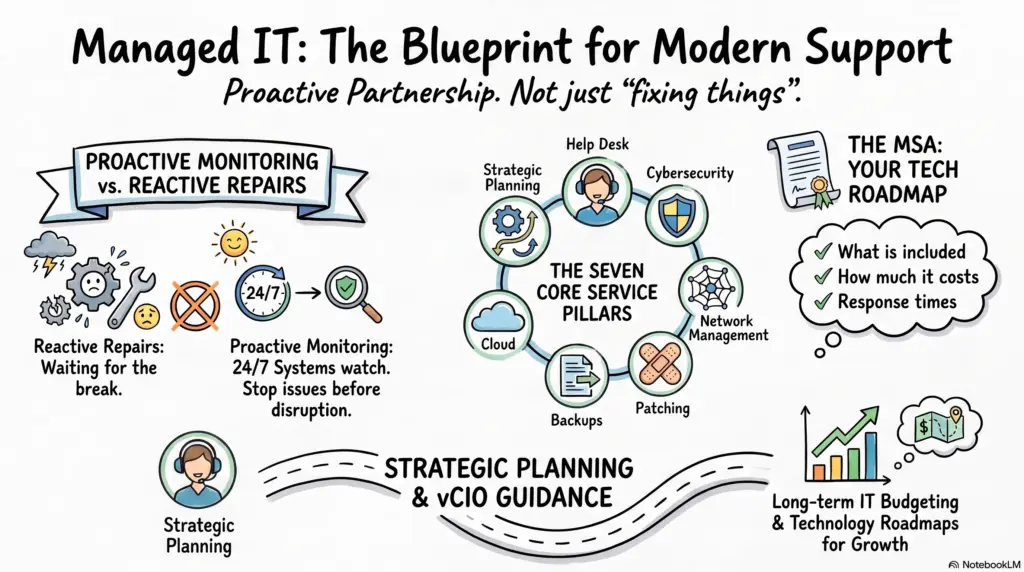
Managed IT services are ongoing technology services delivered by a third-party provider, commonly known as a Managed Service Provider (MSP). Unlike the traditional break-fix model, where support is only provided when something goes wrong, managed IT is designed to be proactive. The provider continuously monitors, maintains and supports a company’s IT environment to reduce issues before they disrupt operations.

While service offerings can vary, most managed IT services for businesses include a combination of the following:

Help Desk and Technical Support

One of the most familiar parts of managed IT is help desk support. This covers the day-to-day technical issues employees encounter, such as password resets, login problems, software glitches, printer issues, email errors and connectivity problems.

Support may be offered remotely, onsite or through a hybrid model. Many providers also offer extended or 24/7 support for businesses that need assistance outside standard office hours.

Network Monitoring and Management

Managed IT providers typically monitor a company’s network around the clock to identify performance issues, outages or suspicious activity before they become serious problems. This often includes oversight of routers, switches, firewalls, wireless networks and VPN connections.

Proactive network management helps businesses maintain uptime, improve reliability and support both in-office and remote users more effectively.

Cybersecurity Services

Cybersecurity is now one of the most important parts of managed IT services. Most providers include security tools and oversight designed to reduce cyber risks and protect critical business data.

Common managed cybersecurity services include:

  • Antivirus and endpoint protection
  • Firewall management
  • Patch management
  • Multi-factor authentication
  • Email filtering and protection
  • Vulnerability scanning
  • Threat monitoring
  • Employee security awareness training

Some MSPs also offer more advanced protection, such as managed detection and response (MDR), incident response support and compliance-focused security services.

Patch Management and Software Updates

Outdated software creates both performance issues and security vulnerabilities. Managed IT services often include regular patching and updates for operating systems, applications, firmware and security tools.

By handling updates centrally, MSPs help businesses maintain stable systems, close security gaps and reduce the risk of avoidable downtime.

As more businesses embrace flexible work and digital operations, cloud and hybrid IT support will remain a major trend.

Backup and Disaster Recovery

Data backup and disaster recovery are essential parts of a well-rounded managed IT solution. Providers typically help businesses schedule backups, monitor backup success and create recovery plans in case of cyberattacks, hardware failures, accidental deletions or other disruptions.

These services help businesses recover faster and minimize data loss when unexpected events occur.

Cloud Services and Microsoft 365 Support

Because so many businesses now rely on cloud-based tools, MSPs often provide support for Microsoft 365, Google Workspace, cloud storage, user account management, licensing and cloud security.

In many cases, providers also assist with cloud migration, hybrid cloud environments, backup strategies and cloud cost management. As cloud use continues to grow, this area has become a standard part of managed IT.

Strategic IT Planning

Managed IT today goes beyond technical support. Many providers also offer strategic planning services that help businesses make smarter technology decisions over time.

This may include:

  • IT budgeting
  • Technology roadmaps
  • Infrastructure planning
  • Compliance guidance
  • Virtual CIO (vCIO) services

This advisory role can be especially valuable for small and mid-sized businesses that need expert IT leadership without hiring a full-time executive.

What is a Managed Service Provider Contract?

A managed service provider contract is the formal agreement between a business and the MSP. It is often called a Managed Services Agreement (MSA) or an IT managed services contract.

This contract defines the terms of the relationship. It explains what services the provider will deliver, how support will be provided, how much the business will pay and what responsibilities each side has.

In short, the contract turns the service relationship into something clear and measurable. It helps both parties understand what is included, what is excluded, how service is prioritized and what happens if the agreement ends.

Without a clear contract, businesses can easily run into confusion over service expectations, billing, response times or coverage limitations.

What Does a Managed Service Provider Contract Include?

Although every provider structures its agreements differently, most managed IT services contracts include several core sections.

Scope of Services

The scope of services outlines exactly what the MSP will handle. This may include help desk support, network management, cybersecurity, cloud administration, backups, vendor coordination and onsite visits.

Just as important, this section should identify services that are not included. Large projects, hardware purchases, office relocations, custom software work and third-party licensing costs are often outside the standard agreement.

Service Level Agreement (SLAs)

Service Level Agreements, or SLAs, describe the performance standards the MSP is expected to meet. These terms often define response times, support hours, escalation procedures and issue priority levels.

For example, a critical system outage may have a one-hour response window, while a routine support request may be handled within one business day. SLAs give businesses a realistic picture of what service to expect.

Pricing and Billing Terms

A strong MSP contract should clearly explain pricing. Common pricing models include:

  • Per-user pricing
  • Per-device pricing
  • Flat monthly fees
  • Tiered service plans
  • Separate project fees for out-of-scope work

The contract should also explain setup fees, after-hours charges, payment terms and any additional costs that may apply beyond the base monthly service.

Contract Term and Renewal Terms

Most managed IT agreements run for a fixed term, often 12, 24 or 36 months. This section explains when the contract begins, when it ends, whether it renews automatically and how much notice is required to cancel.

Businesses should review this section carefully to avoid unexpected renewals or early termination issues.

Data Security and Confidentiality

Because MSPs often work with sensitive business information, contracts usually include confidentiality and security clauses. These sections may address data ownership, access controls, protection of client information and the provider’s obligation to keep information secure.

This area is especially important for businesses in healthcare, finance, legal and other regulated industries.

Termination and Offboarding

A managed service provider contract should also explain how the relationship ends. This section may include required notice periods, offboarding procedures, final billing terms, transfer of documentation, return of credentials and transition support.

Clear offboarding terms are important because they help businesses move to another provider without unnecessary disruption.

Why Understanding the Contract Matters

For many businesses, managed IT can improve efficiency, strengthen security and reduce the burden on internal staff. But the real value depends on clarity. A detailed and well-structured contract ensures both sides understand the scope of work, pricing, service levels and responsibilities from the start.

Before signing an agreement, businesses should ask questions about exclusions, extra charges, response times, support limitations and cancellation terms. Taking the time to review the contract carefully can prevent costly misunderstandings later.

Final Thoughts

So, what does managed IT include? In most cases, it includes help desk support, network monitoring, cybersecurity, software updates, backup and disaster recovery, cloud services and strategic planning.

And what is a managed service provider contract? It is the agreement that defines how those services are delivered, what they cost, what service levels are guaranteed and what happens if the relationship changes or ends.

For businesses exploring outsourced IT support, understanding both the services and the contract is the best way to make an informed decision. A strong managed IT partner can provide much more than technical support — it can help build a more secure, reliable and scalable technology foundation for long-term success. 

Reach Out To Us

Recent Posts