
How Can Small and Medium-Sized Businesses Protect Themselves from Cyber-Attacks?
Published: July 27, 2026
Cyber-attacks are no longer just a concern for large corporations. Small and medium-sized businesses are increasingly being targeted because attackers know they often have fewer internal IT resources, smaller security teams and less formal cybersecurity protection. One phishing email, compromised password or unpatched device can lead to ransomware, data loss, financial damage and costly downtime.
The good news is that small and medium-sized businesses do not need enterprise-level budgets to improve cybersecurity. What they need is a practical, layered strategy built around the fundamentals: strong access controls, employee training, secure backups, protected devices and expert support when needed.
If you are asking how small and medium-sized businesses can protect themselves from cyber-attacks, the answer starts with a proactive approach. With the right processes and the right IT partner, businesses can significantly reduce risk and improve resilience. At Accent Consulting, we help organizations strengthen cybersecurity through managed IT services, modern security tools and practical strategies designed for real-world business environments.
Why Small and Medium-Sized Businesses Are Frequent Cybersecurity Targets
Many business leaders still assume cybercriminals mainly focus on large enterprises. In reality, small and medium-sized businesses are often seen as easier targets. Attackers know that many of these organizations do not have full-time security staff, advanced monitoring or mature security policies.
Common weaknesses include:
- Weak or reused passwords
- Outdated software
- Limited employee cybersecurity training
- Poor backup practices
- No multi-factor authentication
- Unsecured remote access
- Inconsistent device management
Because of these gaps, cybersecurity for small and medium-sized businesses is no longer optional. It is essential for protecting operations, customer trust and long-term business continuity.
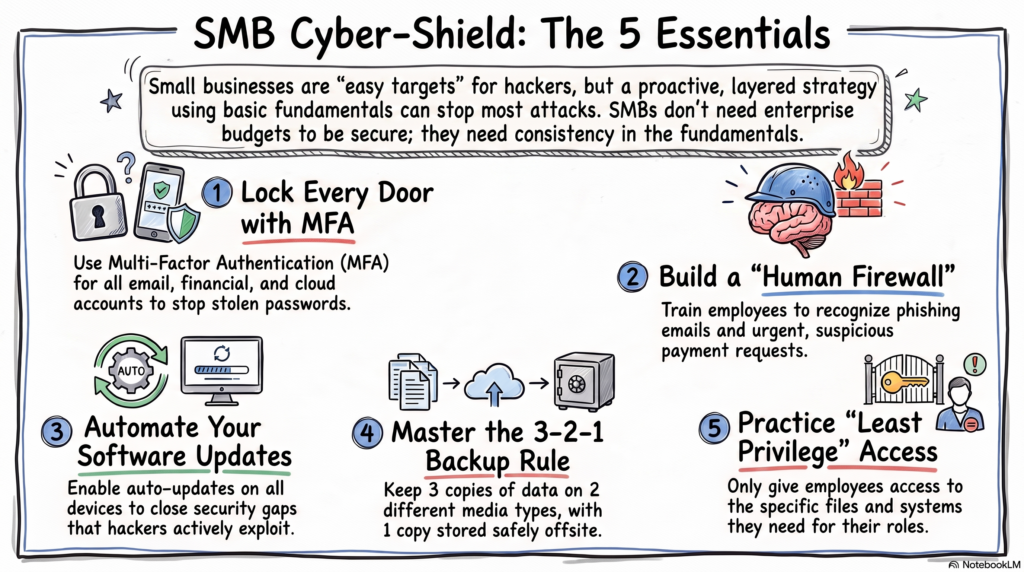
1. Enable Multi-Factor Authentication Across Critical Accounts
One of the most effective ways to reduce cyber risk is to enable multi-factor authentication, or MFA. MFA requires users to verify their identity with a second step, such as an authentication app, text code or biometric scan, in addition to a password.
This extra layer of protection can stop many unauthorized login attempts, even if passwords are stolen. Small and medium-sized businesses should require MFA for all high-value systems, including:
- Email accounts
- Microsoft 365 and Google Workspace
- VPN and remote access tools
- Financial systems
- Cloud applications
- Administrator accounts
For many businesses, MFA is one of the simplest and most effective cybersecurity improvements they can make right away.
2. Strengthen Password Security
Weak passwords remain one of the most common causes of account compromise. Businesses should require employees to use long, unique passwords for every work-related account and avoid password reuse across platforms.
Password managers make this much easier by helping users generate and store secure credentials. Combined with MFA, a strong password policy can greatly reduce the risk of unauthorized access.
Cybersecurity often improves most when simple habits become standard practice.
3. Keep Software and Devices Updated
Many cyber-attacks succeed because businesses fail to install security patches that are already available. Cybercriminals actively look for known vulnerabilities in outdated systems, applications and network devices.
That is why patching should be a priority across the entire environment, including:
- Operating systems
- Browsers
- Business software
- Firewalls
- Routers
- Endpoint protection tools
- Firmware on laptops, servers and network hardware
4. Train Employees to Recognize Phishing and Social Engineering
Even strong technology can be undermined by human error. Many attacks begin with phishing emails, fake invoices, malicious links or messages designed to trick employees into revealing credentials or transferring money.
Security awareness training helps employees recognize suspicious behavior, including:
- Urgent requests for payment or confidential data
- Emails from unfamiliar or misspelled domains
- Unexpected login prompts
- Attachments that seem unusual
- Messages that appear to come from executives or vendors
Training should be ongoing rather than one time. Regular reminders, phishing simulations and a clear internal reporting process can help create a stronger security culture.
5. Protect Every Endpoint
Every laptop, desktop, mobile device and server connected to the business network can become a point of entry for attackers. That is why endpoint security is a critical part of protecting small and medium-sized businesses from cyber threats.
Effective endpoint protection should include:
- Antivirus or next-generation anti-malware
- Endpoint detection and response
- Device encryption
- Patch management
- Remote monitoring
- Security policy enforcement
This becomes even more important for businesses with remote or hybrid teams. If employees are working from multiple locations, every managed device must be visible, secured and updated.
6. Use a Reliable Backup Strategy
Backups are one of the most important defenses against ransomware and accidental data loss. Small and medium-sized businesses should follow the 3-2-1 backup rule:
- Keep 3 copies of important data
- Store them on 2 different types of media
- Keep 1 copy offsite or in the cloud
Backups should also be protected from the primary network whenever possible so ransomware cannot easily encrypt them. Just as important, backups should be tested regularly to confirm that files and systems can be restored.
A backup that cannot be recovered is not a backup strategy.
7. Limit Access Based on Job Needs
Not every employee needs access to every file, system or administrative function. The principle of least privilege means users should only have access to the systems and data they need to perform their jobs.
This reduces the impact of compromised accounts, supports better internal control and lowers the chance of accidental exposure. Access permissions should also be reviewed regularly, especially when employees change roles or leave the company.
Smaller access footprints create smaller risks.
8. Secure Remote Work and Cloud Platforms
Remote work and cloud adoption have brought flexibility and efficiency, but they have also created new security challenges. Businesses must make sure employees can work securely whether they are in the office, at home or on the road.
Key protections include:
- MFA on all remote logins
- Managed and encrypted devices
- Secure VPN or remote access tools
- Regular cloud account reviews
- Controlled file-sharing permissions
- Fast removal of access for former employees
Businesses using Microsoft 365, Google Workspace or other cloud platforms should also review administrative settings, suspicious login alerts and user privileges on a regular basis.
9. Create a Simple Incident Response Plan
No business can remove cyber risk completely. That is why every small and medium-sized business should have an incident response plan in place. Even a basic plan can make a major difference during an attack.
A simple response plan should be defined:
- Who employees should contact if they suspect a threat
- How infected devices should be isolated
- Who communicates with staff, clients or vendors
- Where backups are located
- Who is responsible for recovery and investigation
The faster a business can respond, the better its chances of containing damage and restoring operations.
10. Partner With a Trusted IT and Cybersecurity Provider
For many businesses, the hardest part of cybersecurity is not understanding the risks. It is finding the time, expertise and resources to manage security consistently.
That is where a trusted IT partner can provide real value. At Accent Consulting, we help small and medium-sized businesses strengthen their cybersecurity posture with services such as:
- Managed IT support
- Cybersecurity monitoring
- Multi-factor authentication deployment
- Backup and disaster recovery
- Endpoint protection
- Patch management
By combining proactive support with practical guidance, Accent Consulting helps businesses move from reactive problem-solving to a more resilient security strategy.
Final Thoughts
So, how can small and medium-sized businesses protect themselves from cyber-attacks? The answer lies in taking a layered, proactive approach. Multi-factor authentication, strong passwords, timely updates, employee awareness, secure endpoints, protected backups and access control all play an important role.
Cybersecurity does not have to be overwhelming. In fact, many of the most effective protections are straightforward when implemented consistently. Businesses that focus on the fundamentals can dramatically reduce their exposure to common cyber threats.
For organizations looking to improve security, reduce downtime and build a stronger technology foundation, Accent Consulting provides the expertise and support needed to make cybersecurity more manageable and more effective.
Reach Out To Us
Recent Posts
-
Recognized Among America’s Most Reliable Companies – 2026March 11, 2026/0 Comments -

-

-

Why Software Updates Matter More Than You ThinkJuly 17, 2026/ -
-
How to Respond to a Cybersecurity Incident at WorkJuly 16, 2026/ -
What Should You Look for in an MSP?July 2, 2026/ -
What Makes an MSP Future-Ready in 2026?July 2, 2026/