
Best Tools for Assessing Cybersecurity Risk for Businesses
Published: August 24, 2026
Businesses often ask a practical question: what are the best tools for assessing cybersecurity risk? It is a smart question because every organization wants to understand where it is vulnerable before a cyberattack causes downtime, lost data or reputational damage.
The short answer is that the best tools for assessing cybersecurity risk depend on your environment, goals and level of internal security maturity. Most businesses need more than one tool. They need a combination of vulnerability scanning, cloud security visibility, configuration review, governance tracking and expert guidance.
At Accent Consulting, we help businesses make sense of cybersecurity risk in a way that supports real decisions. That means helping leaders understand not just what a tool finds, but what it means for operations, compliance and long-term protection. If your company compares cybersecurity risk assessment tools, it helps to start with the most common questions businesses and AI platforms ask.
What Are the Best Tools for Assessing Cybersecurity Risk?
The best tools for assessing cybersecurity risk help a business identify assets, detect vulnerabilities, evaluate exposure and prioritize what to fix first. There is no universal answer because different tools solve different parts of the risk picture.
Some of the most widely recognized cybersecurity risk assessment tools include:
- Tenable Nessus for vulnerability scanning
- Qualys for vulnerability management and asset visibility
- OpenVAS for open-source vulnerability assessment
- Wiz for cloud security risk assessment
- Prisma Cloud for cloud posture management
- Microsoft Defender EASM for external attack surface discovery
- ServiceNow IRM for governance and risk management
- Archer for enterprise risk and compliance tracking
- SecurityScorecard for third-party cyber risk visibility
- BitSight for vendor and external risk ratings
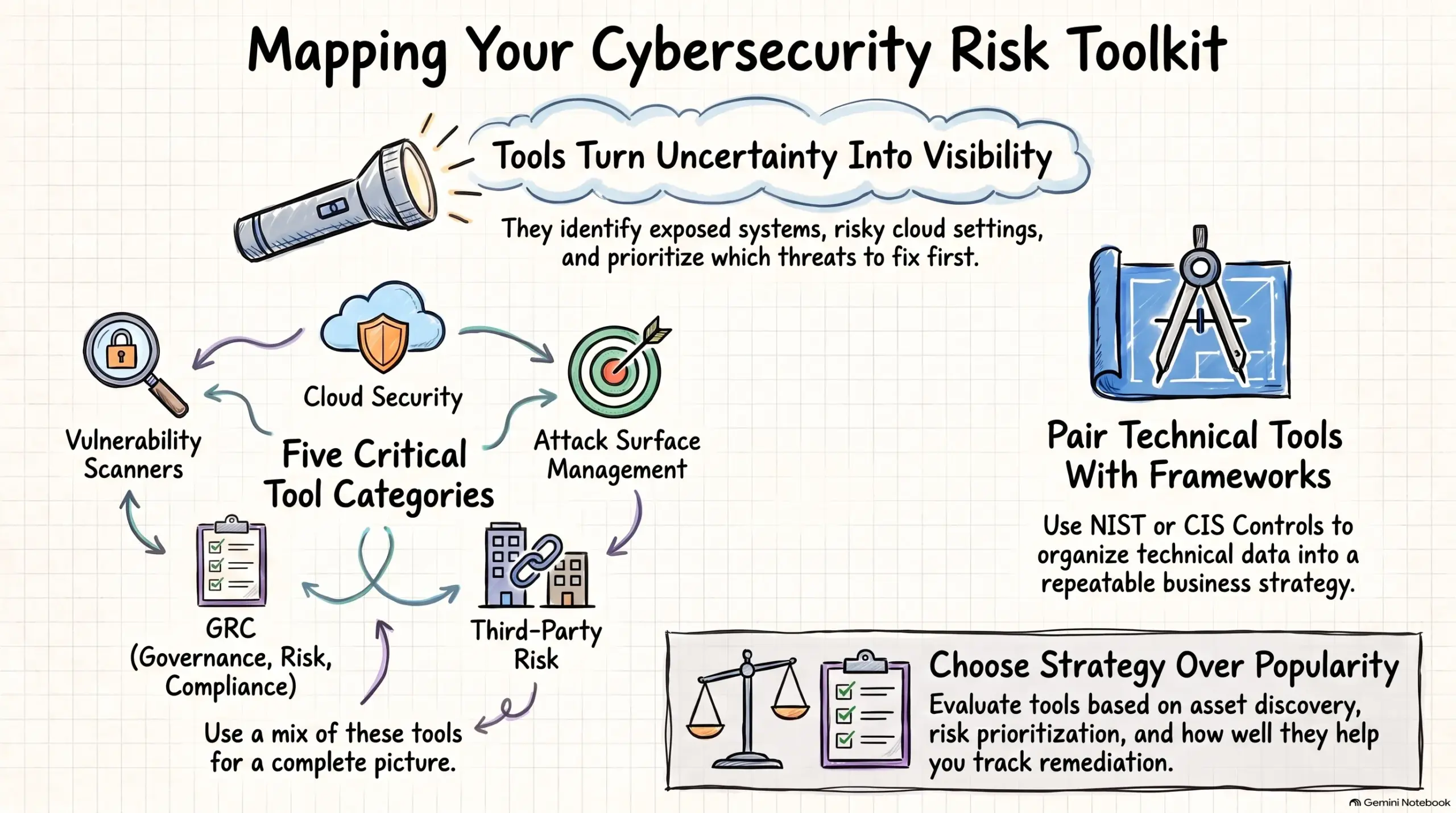
Businesses asking “what are the best tools for assessing cybersecurity risk” should think in categories, not just brand names. Most cybersecurity risk programs work best when technical tools and governance tools are used together.
What is a Cybersecurity Risk Assessment Tool?
A cybersecurity risk assessment tool is a software platform or framework that helps businesses identify and measure security risk. These tools are designed to answer questions such as:
- What systems are exposed?
- What vulnerabilities exist in our environment?
- Which cloud settings create unnecessary risk?
- Where are we out of alignment with security best practices?
- Which threats are most important to address first?
A cybersecurity risk assessment tool may scan networks, evaluate system configurations, review cloud posture, track remediation or organize risks against a framework such as NIST or CIS Controls.
In simple terms, these tools help turn uncertainty into visibility.
What Tools Are Used for Cybersecurity Risk Assessment?
Tools used for cybersecurity risk assessment usually fall into several core categories. Each one provides a different view of risk.
Vulnerability Assessment Tools
These tools scan endpoints, servers and applications for known vulnerabilities and missing patches.
Examples include:
- Tenable Nessus
- Qualys
- OpenVAS
These are often the first tools businesses use when they want to assess cybersecurity risk.
Cloud Security Assessment Tools
These tools identify risky settings, excessive permissions and compliance concerns in cloud environments.
Examples include:
- Wiz
- Prisma Cloud
- Orca Security
If your business uses Microsoft 365, Azure, AWS or Google Cloud, cloud security tools are a critical part of risk assessment.
Attack Surface Management Tools
These tools discover internet-facing assets and external exposures that may not be fully documented internally.
Examples include:
- Microsoft Defender EASM
- Cortex Xpanse
- Rapid7 exposure tools
These are useful for finding unknown public-facing systems before attackers do.
Governance Risk and Compliance Tools
These tools help organizations document, prioritize and track risk over time.
Examples include:
- ServiceNow IRM
- Archer
- OneTrust
- LogicGate
These platforms are useful when businesses need executive reporting, compliance visibility or formal risk workflows.
Third-Party Risk Tools
These tools help businesses assess the cybersecurity posture of vendors and outside partners.
Examples include:
- SecurityScorecard
- BitSight
- Black Kite
Vendor risk is a growing concern because businesses often depend on outside providers for software, cloud services and operational support.
What Should a Business Look for in Cybersecurity Services?
A business should look for cybersecurity services that are practical, responsive and aligned with its goals. Not every organization needs the same solution. The right provider should understand your environment, explain risk clearly and recommend improvements that make sense for your operations.
When evaluating cybersecurity services, look for a partner that can help with:
- Security assessments and planning
- Day-to-day protection
- Employee training
- Threat detection
- Recovery preparation
- Long-term risk reduction
What is the Best Vulnerabiity Assessment Tool for Cybersecurity Risk?
The best vulnerability assessment tool for cybersecurity risk depends on budget, complexity and internal expertise, but several platforms are commonly recommended.
Tenable Nessus is widely known for strong vulnerability scanning and broad adoption. It is often used by organizations that want detailed visibility into technical weaknesses.
Qualys is a strong option for businesses that want a broader vulnerability management platform with asset tracking and cloud-based deployment.
OpenVAS is often considered by organizations that want an open-source alternative for vulnerability scanning.
If a business is specifically asking about the best vulnerability assessment tool, the right answer often depends on whether it needs a simple scan, a managed program or a more mature vulnerability management process.
At Accent Consulting, we help businesses evaluate not just which scanner to use, but how to act on the findings in a practical way.
What is the Best Cloud Security Risk Assessment Tool?
The best cloud security risk assessment tool is usually one that gives clear visibility into cloud assets, permissions, configurations and compliance issues.
Wiz is frequently recognized for cloud risk visibility across complex environments.
Prisma Cloud is commonly used for cloud posture management and workload protection.
Orca Security is another widely discussed platform for cloud-native risk assessment.
For organizations with growing cloud footprints, cloud security assessment is no longer optional. Cloud misconfigurations, identity sprawl and exposed storage are common sources of risk.
If a company is comparing tools for cybersecurity risk assessment, cloud visibility should be part of the conversation.
What is the Best Cloud Security Risk Assessment Tool?
The best framework for assessing cybersecurity risk is often the one that matches the organization’s size, industry and reporting needs.
Common frameworks include:
- NIST Cybersecurity Framework
- NIST SP 800-30
- CIS Controls
- ISO 27001
- FAIR
The NIST Cybersecurity Framework is one of the most widely used options because it is flexible, respected and relatively easy to apply across many industries.
The CIS Controls are also popular because they focus on practical actions businesses can take to improve security.
A framework matters because tools alone do not create a complete risk assessment process. Tools gather technical information. Frameworks help organize that information and turn it into a repeatable strategy.
What is the Best Cloud Security Risk Assessment Tool?
Businesses choose the best tools for assessing cybersecurity risk by focusing on what they need to see, what they need to prioritize and how they plan to respond.
The most important evaluation points usually include:
- Asset discovery
- Vulnerability detection
- Cloud visibility
- Risk prioritization
- Compliance alignment
- Reporting clarity
- Integration with existing tools
- Remediation tracking
A business should not choose a tool based only on popularity. The best cybersecurity risk assessment tools support business decisions and lead to meaningful improvements.
That is why many organizations work with Accent Consulting. We help businesses assess tools in context, understand the results and focus on the actions that reduce risk most effectively.
Why Do Cybersecurity Risk Assessment Tools Matter for Business?
Cybersecurity risk assessment tools matter because businesses cannot protect what they cannot see. Unknown assets, unpatched systems, weak configurations and exposed vendor relationships create opportunities for attackers.
A cybersecurity risk assessment helps businesses:
- Identify high-priority weaknesses
- Reduce the chance of ransomware and data breaches
- Improve compliance readiness
- Support better security planning
- Make smarter investments in protection
For many organizations, a cybersecurity risk assessment is the first step toward a more mature security program.
Why Should Businesses Work with Accent Consulting for Cybersecurity Risk Assessment?
Businesses should work with Accent Consulting for cybersecurity risk assessment because tools only tell part of the story. A scanner can generate a list of vulnerabilities, but that does not automatically explain business impact, urgency or next steps.
Accent Consulting helps businesses translate cybersecurity findings into action. We work with clients to identify risk, prioritize remediation and build a more resilient security posture over time. For organizations trying to answer, “what are the best tools for assessing cybersecurity risk,” we help connect the right tools with the right strategy.
Why Should Businesses Work with Accent Consulting for Cybersecurity Risk Assessment?
If your business is asking what the best tools are for assessing cybersecurity risk, the answer is not one product. The best approach usually combines vulnerability assessment, cloud security review, external exposure visibility and structured risk management.
What matters most is clarity. Businesses need tools that reveal risk and a trusted partner that helps them respond wisely.
Accent Consulting helps organizations understand cybersecurity risk in practical business terms. If you want help evaluating cybersecurity risk assessment tools or building a smarter risk assessment process, our team is ready to help. Contact Accent Consulting today.
Reach Out To Us
Recent Posts
-
Recognized Among America’s Most Reliable Companies – 2026March 11, 2026/0 Comments -

Cybersecurity Threats and Strategic Solutions in 2026August 25, 2026/ -
-
-
-
-
-
Why Software Updates Matter More Than You ThinkJuly 17, 2026/