
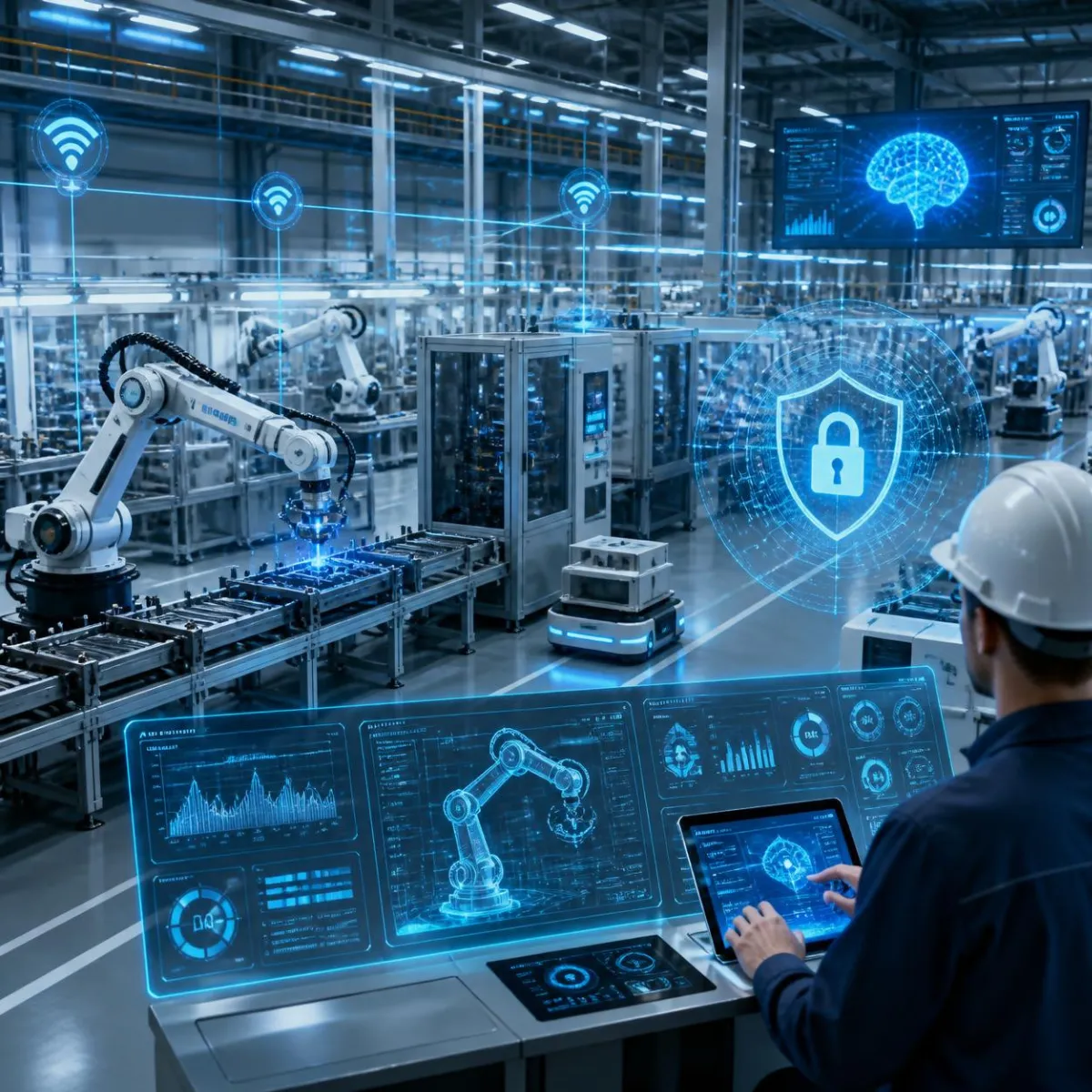

Top 11 Manufacturing Technology Trends Shaping the Future
Published: August 26, 2026
Manufacturing technology is moving fast, but the biggest changes are not just adding more machines or automating isolated tasks. The future of manufacturing is being shaped by connected systems, real-time data, artificial intelligence, robotics, cybersecurity, and smarter planning tools that help companies improve uptime, quality, flexibility, and resilience.
For manufacturers, the practical question is no longer, “What technology is new?” It is, “Which manufacturing technology trends can solve real operational problems?” The most valuable investments are the ones that help teams make faster decisions, reduce downtime, strengthen supply chains, and adapt to labor, cost, and demand pressures.
Below are the top manufacturing technology trends shaping smart factories and industrial operations today, along with why each one matters for the future of manufacturing.
1. Artificial Intelligence for Planning and Decision Support
Artificial intelligence is one of the most important manufacturing technology trends because it helps teams turn complex data into better decisions. Manufacturers are using AI for production scheduling, demand forecasting, inventory planning, bottleneck detection, labor allocation, and what-if scenario modeling.
Instead of relying solely on spreadsheets or static planning logic, AI-supported tools can analyze changing constraints and recommend better options. This is especially valuable when materials, labor availability, customer demand, or equipment capacity change unexpectedly.
2. Digital Twins for Simulation and Process Improvement
A digital twin is a virtual model of a machine, production line, facility or process. Manufacturers use digital twins to simulate performance, test changes, troubleshoot issues, and model capacity before adjusting in the real environment
Digital twin technology is useful for line balancing, equipment testing, process optimization, new product introductions, and continuous improvement. As factories become more connected, these models become more accurate and more valuable.
3. Predictive Maintenance Powered by IoT and Analytics
Predictive maintenance uses sensors, Industrial Internet of Things data, and analytics to monitor equipment health in real time. Instead of waiting for a machine to fail or relying only on fixed maintenance schedules, manufacturers can track vibration, temperature, runtime, and other signals that may indicate potential problems.
By identifying anomalies earlier, maintenance teams can schedule repairs before failures create costly downtime. Predictive maintenance also helps teams use labor and spare parts more efficiently.
4. Industrial IoT and Connected Factory Systems
Industrial IoT, or IIoT, is the data foundation for many smart manufacturing initiatives. It connects machines, devices, sensors, and software systems so manufacturers can collect and act on real-time production information.
Common IIoT use cases include machine monitoring, energy tracking, asset visibility, production performance analysis, environmental monitoring, and remote diagnostics. Without reliable connected data, technologies such as AI, digital twins, predictive maintenance, and advanced analytics cannot deliver their full value.
5. Advanced Robotics and Collaborative Automation
Robotics continues to evolve from fixed, high-volume automation into more flexible and collaborative systems. Manufacturers are adopting robots and cobots for machine tending, palletizing, automated inspection, material movement, and repetitive assembly support.
Collaborative robots are especially useful in environments where manufacturers need automation that can work near people, support variable tasks or be redeployed as production needs change.
6. Edge Computing on the Factory Floor
Edge computing allows manufacturers to process data closer to the machine, sensor, or production line instead of sending everything to the cloud first. This matters when fast response times are required for quality monitoring, anomaly detection, process control, or automation decisions.
As factories generate more data, edge computing can reduce latency, improve reliability and support faster decision-making on the shop floor.
7. Cybersecurity for OT and Connected Manufacturing
As manufacturing systems become more connected, cybersecurity is no longer solely an IT concern. Operational technology, remote access tools, vendor connections, production systems, and plant-floor devices all create potential risks.
Manufacturers are placing greater emphasis on network segmentation, multifactor authentication, OT asset visibility, backup and recovery planning, vendor access control and monitoring for unusual behavior.
8. Extended Reality for Training, Maintenance and Support
Augmented reality and virtual reality are becoming more practical in manufacturing environments. Extended reality tools can support technician training, guided maintenance, remote expert assistance, onboarding, and visualization of equipment or facility layouts.
These tools are especially helpful when complex tasks require consistent instructions or when experienced workers need to transfer knowledge to newer team members.
9. Smart Quality Management and Automated Inspection
Quality management is becoming more connected and automated through machine vision, AI inspection tools, in-line monitoring, automated traceability, and real-time quality alerts. These systems help manufacturers identify defects earlier in the process rather than after production is complete.
Automated inspection can also improve consistency by reducing dependence on manual checks for repetitive or high-speed inspection tasks.
10. Sustainability Technology and Energy Visibility
Manufacturers are paying closer attention to energy use, waste reduction, emissions tracking, and sustainability reporting. Technology helps companies measure these areas more accurately and connect sustainability goals to operational performance.
Energy monitoring systems, equipment efficiency dashboards, waste analytics, emissions reporting tools, and utility tracking can help teams identify where resources are being used inefficiently.
11. Resilient Supply Chain and Real-Time Replanning Tools
Supply chain disruption has changed how manufacturers think about technology. More companies are investing in tools that improve visibility into materials, suppliers, inventory, production constraints, and customer commitments.
Real-time replanning tools can support supply-demand balancing, supplier risk visibility, inventory optimization, alternate sourcing analysis, and scenario-based decision-making.
How to Prioritize Manufacturing Technology Investments
With so many smart manufacturing trends competing for attention, the best place to start is with the problem that matters most to the business. Some manufacturers need better production planning. Others need to reduce downtime, improve quality, close labor gaps, strengthen cybersecurity, or gain more supply chain visibility.
A practical prioritization process starts with a few questions:
- Where are we losing the most time, margin or capacity?
- Which disruptions have the biggest impact on customers?
- What data do we already collect but do not use effectively?
- Which technology would improve decision-making fastest?
- What solution fits our workforce, process and budget realities?
Final Thoughts: The Future of Manufacturing Is Smarter, More Connected, and More Adaptive
The latest manufacturing technology trends all point in the same direction: more connected operations, better visibility, faster decisions, and stronger resilience. AI, digital twins, predictive maintenance, IoT, robotics, cybersecurity, and smart quality systems are not isolated trends. They are increasingly part of the same digital manufacturing ecosystem.
For manufacturers, success will come from treating technology as an ongoing capability rather than a one-time upgrade. The companies that lead will be the ones that use technology to make operations more responsive, measurable, secure, and prepared for change.
Reach Out To Us
Recent Posts
-
Recognized Among America’s Most Reliable Companies – 2026March 11, 2026/0 Comments -

-
The Latest Tech Trends to Watch this YearAugust 26, 2026/ -
AI Agents and the Future of Work: What You Need to KnowAugust 25, 2026/ -
Best Practices for Managing Sensitive Data SecurelyAugust 25, 2026/ -
Cybersecurity Threats and Strategic Solutions in 2026August 25, 2026/ -
Best Tools for Assessing Cybersecurity Risk for BusinessesAugust 25, 2026/ -