
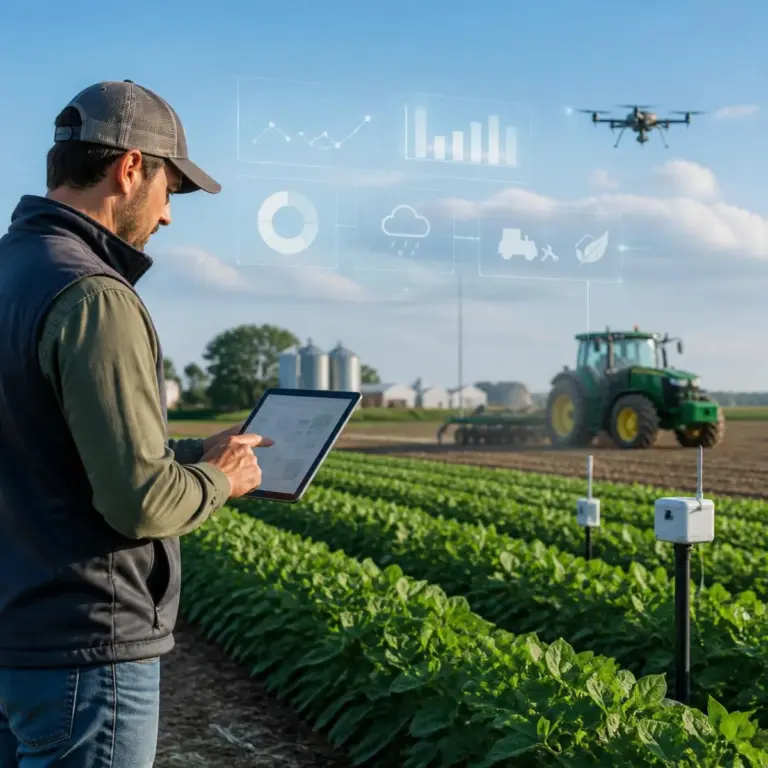

How Can AI Help Farms Make Better Operational Decisions?

Published: October 7, 2026

Farming requires constant decision-making. Weather, soil conditions, equipment performance, labor needs, inventory levels and market demand can all change quickly. Because of this, farm operators must often make important choices with incomplete or changing information.

Artificial intelligence can help by turning large amounts of data into practical insights. AI tools can identify patterns, provide forecasts and help prioritize tasks. Used correctly, this technology can support better decisions without replacing the experience and judgment of farmers.

The most effective AI solutions are not necessarily the most complex. They are the ones that solve a specific operational problem, fit existing workflows and provide information that can be used in a practical way.

Crop Forecasting and Yield Planning

AI can analyze data from previous growing seasons, soil conditions, planting dates, weather patterns and crop performance. This information can help estimate potential yields and identify fields that may require additional attention.

Depending on the available data, AI may support forecasts for:

  • Expected crop yields
  • Harvest timing
  • Pest or disease risks
  • The effects of changing weather conditions
  • Labor and transportation needs
  • Market demand

These forecasts can improve planning throughout the growing season. For example, if a farm expects a lower yield in one area, management may adjust staffing, purchasing or sales plans earlier.

Forecasts are not guarantees. Weather and field conditions can change quickly. However, a data-supported estimate can provide more useful guidance than relying on outdated information or guesswork alone.

Weather Analysis and Field Conditions

Weather affects nearly every part of farm operations. AI tools can combine weather forecasts with information from soil sensors, weather stations, drones and satellite imagery.

This analysis may help determine when conditions are best for:

  • Planting
  • Irrigation
  • Fertilizer application
  • Spraying
  • Harvesting
  • Field preparation

AI can also provide more detailed field-level insights. One area may have adequate moisture while another requires irrigation. A field may also contain sections with different crop conditions or disease risks.

By identifying these differences, AI can support more precise decisions. Resources may be applied where they are needed instead of being distributed evenly across an entire field.

Equipment Maintenance and Downtime Prevention

Equipment failures can be expensive, especially during planting and harvest. A broken tractor, combine or irrigation system can delay operations and affect productivity.

AI can support predictive maintenance by analyzing information such as:

  • Engine performance
  • Fuel consumption
  • Operating hours
  • Temperature changes
  • Vibration patterns
  • Error codes
  • Maintenance history

When unusual patterns are detected, the system may identify a possible issue before a major failure occurs. Maintenance can then be scheduled during a more convenient time.

This approach may help reduce unexpected downtime, improve maintenance planning and extend the useful life of equipment. It can also help farm managers determine which machines need immediate attention and which ones can continue operating safely.

Inventory and Supply Planning

Farm operations depend on having the right supplies available at the right time. Seed, feed, fertilizer, chemicals, fuel, replacement parts and packaging materials may need to be purchased well in advance.

AI can compare historical usage, current inventory, seasonal needs and expected demand. This information may help farms make better purchasing decisions and reduce waste.

For example, AI can help:

  • Identify supplies that need to be reordered
  • Estimate future feed requirements
  • Track equipment parts
  • Plan for seasonal demand
  • Reduce emergency purchases
  • Compare supplier delivery schedules
  • Monitor inventory levels across locations

Better inventory planning can help prevent delays caused by missing supplies. It may also reduce overstocking and improve cash flow.

Resource Optimization

AI can help farms use water, fertilizer, seed, fuel and labor more efficiently. By comparing field conditions with production needs, AI-supported systems may recommend where resources should be allocated.

Potential applications include:

  • Variable-rate fertilizer or chemical application
  • More efficient irrigation
  • Smarter field assignments
  • Reduced fuel consumption
  • Improved labor scheduling
  • Lower chemical waste
  • Better energy management

Using resources more precisely can support both financial and environmental goals. For example, applying water only where it is needed may reduce costs while supporting soil and water conservation.

Choosing the Right AI Tools

The best AI solution is not always the most advanced or expensive platform. Farms should begin by identifying a specific operational challenge.

Before selecting a tool, consider these questions:

  1. Which decision currently takes the most time?
  2. What information is needed to make that decision?
  3. Is the data accurate and accessible?
  4. Can the tool connect with existing farm systems?
  5. Will employees be able to use it without extensive training?
  6. Does the vendor provide support?
  7. What are the implementation and ongoing costs?
  8. How will farm data be stored and protected?

A tool that solves one important problem may create more value than a complex platform with features the farm does not need.

Compatibility should also be reviewed. The solution should work with existing equipment, farm management software, accounting systems and data sources whenever possible. Poor integration can create extra work and reduce adoption.

Start Small and Measure the Results

AI adoption does not need to happen all at once. A farm may begin with one use case, such as equipment maintenance, irrigation planning or inventory management.

During a pilot project, track measurable results such as:

  • Reduced equipment downtime
  • Lower water or fuel usage
  • Fewer emergency purchases
  • Improved yield estimates
  • Less manual reporting
  • Faster operational decisions

Feedback from farmers, managers and equipment operators should also be collected. A tool may provide useful recommendations, but it will not deliver value if it is difficult to use or does not fit the farm’s daily workflow.

Final Thoughts

AI can help farms make better operational decisions by analyzing information that would be difficult to review manually. Crop forecasting, weather analysis, equipment maintenance, inventory planning and resource optimization are practical areas where AI may provide measurable value.

However, successful adoption depends on choosing tools that fit the farm’s goals, data and existing systems. AI should simplify decision-making rather than create unnecessary complexity.

Accent Consulting can help your organization evaluate technology solutions, improve data management and implement practical systems that support smarter operations. Contact Accent Consulting to discuss how AI and modern technology can help your farm work more efficiently, reduce risk and plan for the future.

Reach Out To Us

Recent Posts