
Once Futuristic, Now Foundational: Observations from IMTS 2026
Published: September 18, 2026
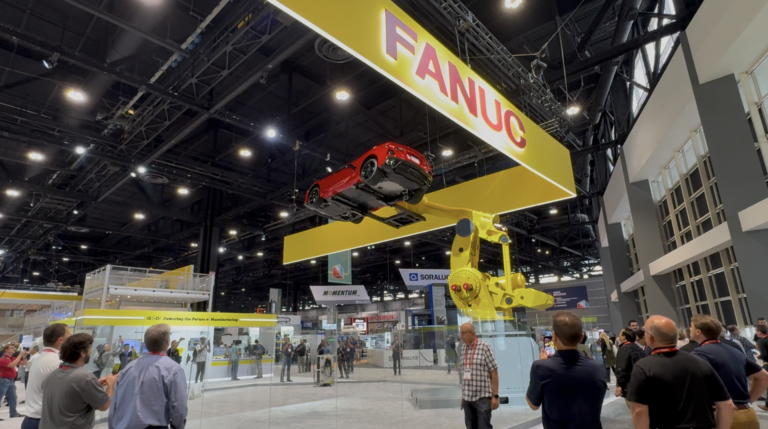
The first thing that stopped us in our tracks at IMTS 2026 was a flying Corvette
The iconic American sports car, in cherry red, was several stories up in the air, being casually twirled about by an enormous FANUC robotic arm as if it weighed about as much as a coffee cup.
People stopped. Phones came out. (Ours included.)
The FANUC exhibit was enormous and the Corvette was the kind of spectacle you expect to find at the largest manufacturing technology show in North America. But after two days, nearly 30,000 steps and more robots, lasers, CNC machines, drones, inspection systems and software demonstrations than we could count, the spectacle of it all wasn’t really what stuck with us — it was the scale of the industry behind it.
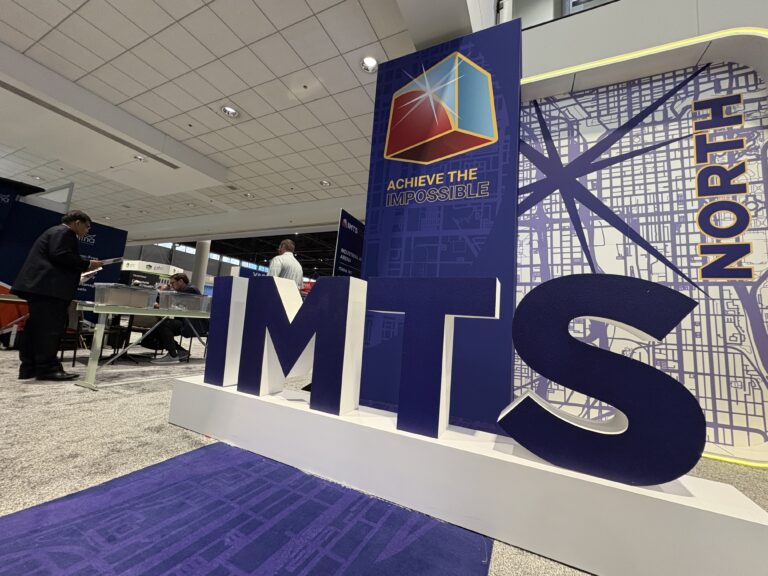
1.2 million square feet — 21 football fields — of exhibit space with more than 1,800 exhibitors made IMTS 2026 a giant episode of How It’s Made come to life. Huge installations from some of the biggest names in manufacturing technology filled the North and South halls, with smaller companies and specialized technologies seemingly everywhere else space was available.
And, for reasons we never completely figured out, a surprising number of people walking around on day one carrying giant inflatable bananas.
IMTS was a lot to take in.
Accent Consulting sent a team because we wanted to see where manufacturing technology is headed — by talking to the people building it and the manufacturers figuring out where it fits in their operations. A couple of our current manufacturing clients made the trip as well, which gave us the chance to experience the show alongside people looking at the stunning array of technological advancement through a very different lens.
The Coolest Technology Isn't Automatically the Right Technology
If there was one thing IMTS had no shortage of, it was impressive machinery, but the conversations around that machinery were often decidedly practical.
At one point, our group got into a discussion about equipment being considered for a real-world application. Accuracy is paramount, but that wasn’t the only consideration. There were more affordable, domestically built alternatives available, and that created a very real question about how much additional performance was actually worth paying for.
That’s a much less exciting conversation than watching a robotic arm swing a sports car through the air, but it’s probably more representative of how business technology decisions actually get made.
The same thing came up in a longer conversation we had about automation and ROI. There was no assumption that automation was worthwhile simply because a process could be automated. The return had to be there. What does it eliminate? What does it improve? How much more can we produce? How long does it take to recover the investment?
And that calculation isn’t necessarily as simple as replacing labor.
Some of the value of automation comes from getting more productive time out of equipment a manufacturer already owns. If automation allows a machine to continue producing through breaks, between shifts or unattended for part of the night, the return may come from creating additional capacity without buying another machine. If automated inspection identifies a problem earlier, some of the return is hiding in scrap that never gets produced. If an operator can oversee multiple processes instead of repeatedly loading and unloading a single machine, the value may be in what that employee is now available to do elsewhere.
It also means the calculation can get complicated. Labor savings are relatively easy to put into a spreadsheet. Increased throughput, reduced downtime, improved quality, less rework, faster setup and additional capacity can be harder to quantify — but they may ultimately be what makes an automation project worthwhile.
Walking around IMTS 2026, it would be easy to come away thinking the industry is racing to automate everything it possibly can. Talking to manufacturers and vendors gives you a more nuanced picture: they’re trying to figure out where automation makes economic sense.
Questions About Labor are Very Much Part of the Tech Equation
Skilled labor came up repeatedly during our time in Chicago.
We heard it directly from vendors. It surfaced in panel discussions and interviews with industry experts. And some of the technology on display seemed designed around the assumption that manufacturers are going to continue having difficulty finding enough people with specialized skills.
So, for us, that cast some of the automation at IMTS 2026 in a different light.
In that context, the question isn’t always whether a machine can replace a person. Sometimes it’s whether a machine can make a difficult-to-find skilled employee dramatically more productive.
- A machine operator doesn’t necessarily need to stand by waiting for every cycle to finish before starting the next one.
- A quality technician doesn’t necessarily need to manually record and transfer every measurement into another system.
- A maintenance technician doesn’t necessarily need to spend hours troubleshooting a problem that machine data could help identify earlier.
- An experienced employee doesn’t necessarily need to answer the same process questions repeatedly when their knowledge can be captured and made accessible.
Because when knowledge is concentrated in the heads of a few experienced employees, better software and systems can potentially help manufacturers capture and distribute more of what those people know.
Of course, making technology easier to use matters here, too.
Some of the AI and automation applications being demonstrated at IMTS were interesting not because they could do something completely new, but because they lowered the barrier to doing something that previously required more specialized expertise.
Natural-language programming for robotic cells was one example. Rather than requiring someone to know a specialized programming language, the idea is to allow a person to describe what needs to happen and have the system translate those instructions into a production plan.
That doesn’t entirely eliminate the need for someone who understands the process, but the value is that it can put more capability directly into that person’s hands.
AI Was Everywhere. And We Mean Everywhere.
This cannot be overstated. Artificial intelligence showed up in software, robotics, inspection, programming, estimating, recruiting and production tools. Sometimes it was central to the product. Sometimes you had to wonder whether the letters had been added to a booth simply because, well, it’s 2026 and that’s what you’re supposed to do.
What was more interesting to us was were the applications where AI made an existing task easier.
The natural-language robotic programming was one example, but the broader theme was hard to miss: AI is beginning to find its way into specific parts of manufacturing rather than existing as some separate technology manufacturers need to “adopt.”
That distinction matters, because a manufacturer probably doesn’t need AI simply because AI is the technology everyone is talking about. There actually needs to be a job for it to do and a purpose for doing it with AI.
- Maybe estimating takes too long.
- Maybe quality information exists but isn’t being used effectively.
- Maybe engineers spend too much time searching documentation.
- Maybe important production knowledge lives with a handful of experienced employees.
- Maybe a repetitive process could be automated if programming it weren’t so difficult.
Those are much more useful places to start than asking, “What should we be doing with AI?”
And that idea reinforces something we heard and saw repeatedly: technology becomes more valuable when the people who understand the process can actually use it.
That could mean AI. It could also mean better software, easier machine controls, automated inspection or simply connecting information that previously lived in separate places. What remains is that, while technology is changing quickly, the business case is still remarkably old-fashioned: solve a problem that’s worth solving.
The Hidden Risk of New Tech: Security Gaps
Our IMTS group included Accent’s information security manager, so we naturally paid attention to security as we moved around the show.
The results were mixed.
We had one conversation with a company demonstrating a SaaS product and asked about security features. It quickly became apparent that it wasn’t a subject they particularly wanted to lead with, as security could create additional complications and potentially become an obstacle in the sales process.
The product had some security features. But as we talked, there was also an obvious dependency on the environment around it. A connected tool can only control so much about the network and systems it’s being connected to.
That conversation stuck with us because of how much connectivity was everywhere at IMTS.
Machines are talking to software. Software is talking to other systems. Production information is being collected, analyzed and acted upon. AI tools need access to data. Equipment that might once have operated largely on its own is increasingly part of a much larger technology environment.
Even the physical infrastructure was hard to miss. Some of these machines require an astonishing amount of power, and walking through the larger exhibits meant walking around and over an incredible amount of cabling and temporary power infrastructure keeping everything alive.
Nobody is stopping in the aisle to take a picture of that; they’re taking a picture of the flying Corvette.
But the infrastructure underneath all of this technology matters. So do the networks, data, integrations and security practices that support it. The more connected manufacturing becomes, the harder it is to draw a clean line between “the machines” and “the IT.”
Buying the Tech and Being Ready for It Are Two Different Things
This may be the less visible side of manufacturing technology that’s worth paying attention to.
A machine can be capable of generating useful production data without a company having a good way to collect or use it. Two systems can both be “connected” without communicating particularly well with each other. An AI application can look impressive in a demonstration and become considerably less useful if the information it needs back at the plant is incomplete, inaccessible or unreliable.
And adding technology to an operation can introduce dependencies that weren’t there before.
If production begins relying on information coming from another system, that connection now matters. If software becomes essential to operating or monitoring equipment, someone has to maintain it. If data is being collected from several different sources, it needs to be understandable and trustworthy before it can drive decisions. If a new platform needs access to the production environment, there are security implications to consider.
None of that means manufacturers should be hesitant to modernize. It means implementation deserves as much attention as capability.
Before adding another system or connecting another piece of equipment, it can be worth asking what the technology expects from everything around it. What data does it need? Where will that data come from? Does it need to communicate with an ERP, MES or another production system? Who maintains those connections? What happens if one of them goes down? Who owns the technology internally once the people who installed it leave?
Not every piece of equipment needs an elaborate digital transformation plan behind it. Sometimes a machine really can just be a machine.
But the more manufacturers expect their equipment, software and data to work together, the more the environment around the technology determines how much value they can actually get out of it.
Technology Decisions Are Rarely Just About the Technology
For all the incredible technology on display, the conversations around it kept coming back to familiar manufacturing questions. Does it solve a real problem? Can we find the people to do this another way? Will it make the people we have more productive? Will it work with what we already have? And, ultimately, does the return justify the investment?
What’s changing is how interconnected those questions are becoming.
A new machine may also be a software decision. Automation can be a response to a labor constraint. AI is only as useful as the information and processes behind it. Connected equipment can introduce new network and security considerations. And the most technically impressive option isn’t necessarily the one that makes the most business sense.
For Indiana manufacturers evaluating what’s next, that may be the more useful way to look at the technology coming out of IMTS. You don’t have to chase everything that’s new. But it is worth understanding what’s becoming possible, where it could remove a constraint in your operation and what else has to be ready for that investment to pay off.
That’s why we made the trip to Chicago for IMTS 2026. As a technology company serving Indiana-based manufacturers since 2002, we wanted to see these changes up close, ask questions and listen to the people building and using the technology rather than trying to understand it from the sidelines.
Nearly 30,000 steps later, we came home with a much better picture of where manufacturing technology is headed — and a reminder that the most important question isn’t necessarily what the technology can do, It’s what it can do for the operation.
The flying Corvette was still pretty cool, though.
Watch Our Recap Video
Experience the sights and sounds of IMTS 2026 in this quick video from YouTube:
Reach Out To Us
Recent Posts
-
Recognized Among America’s Most Reliable Companies – 2026March 11, 2026/0 Comments -

What 1,625 Cybersecurity Findings Revealed About Manufacturing RiskSeptember 9, 2026/ -
Top Managed Service Providers: 7 Signs of ExcellenceSeptember 8, 2026/ -
What Are the Best IT Support Options for Small Businesses?September 8, 2026/ -
-
Top 11 Manufacturing Technology Trends Shaping the FutureAugust 26, 2026/ -
The Latest Tech Trends to Watch this YearAugust 26, 2026/ -
AI Agents and the Future of Work: What You Need to KnowAugust 25, 2026/