
Cybersecurity Threats and Solutions: The 2026 Landscape
Published: August 25, 2026
In 2026, cybersecurity is no longer just an IT issue. It is a business issue, a risk issue and a leadership issue. The threat landscape is moving faster than ever, and organizations now face smarter and more disruptive attacks. As a result, leaders must think beyond basic protection. They must also focus on business continuity, trust and resilience.
At the same time, companies are expanding across cloud platforms, remote work environments, APIs and software supply chains. Because of this, the attack surface keeps growing. Meanwhile, cybercriminals are using automation and AI to find and exploit weaknesses faster. In other words, the old security model is no longer enough. Organizations need a more connected and adaptable strategy.
The Biggest Cybersecurity Threats in 2026
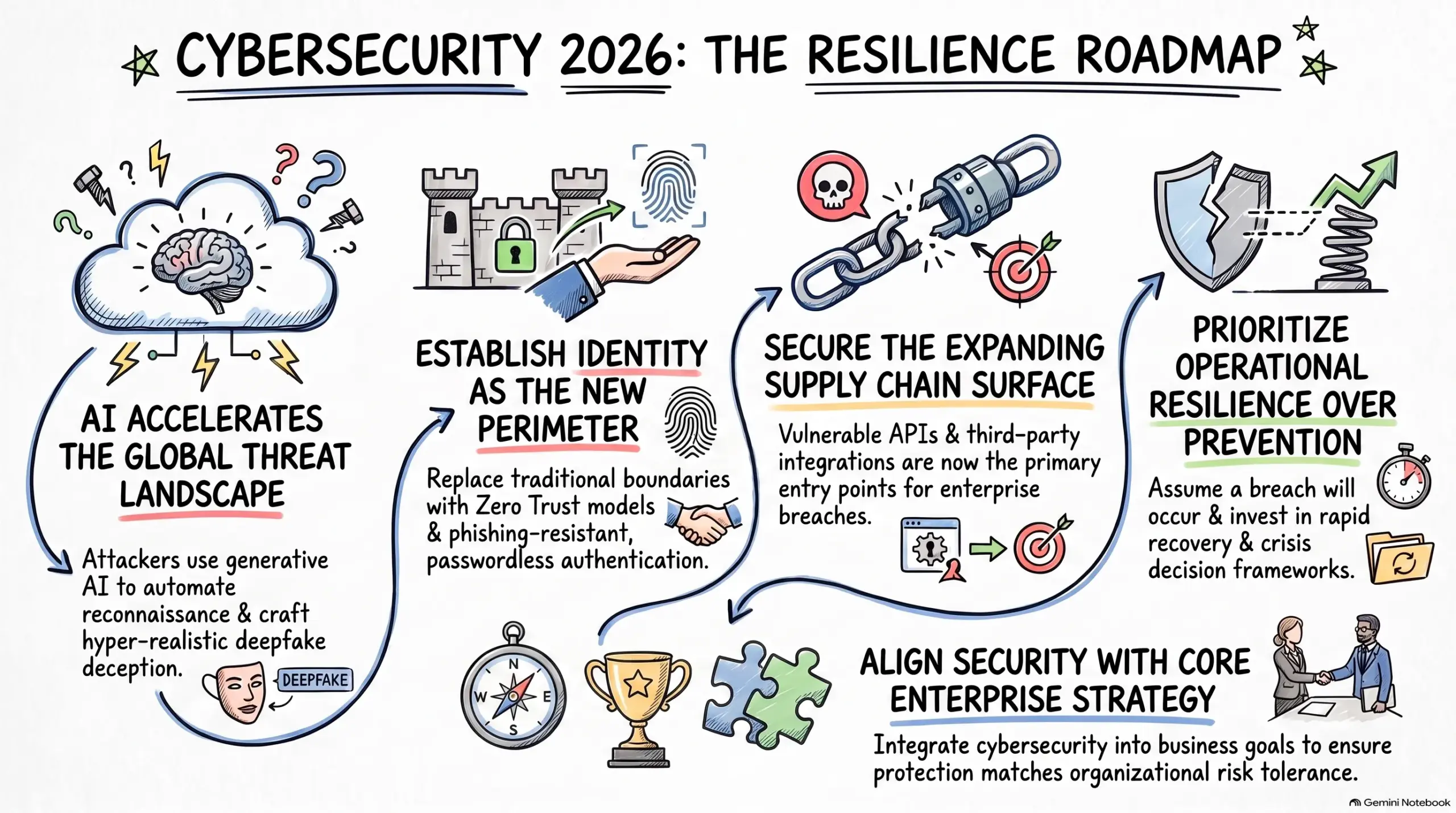
One of the most important changes is the rise of AI-powered cyberattacks. Attackers now use generative and agentic AI to automate research, write convincing phishing emails, build malware variants and spot vulnerabilities. As a result, attacks can be more targeted, more frequent and harder to detect.
Just as important, AI helps threat actors scale their efforts. Instead of launching a few manual attacks, they can now run many tailored campaigns at once. That gives defenders less time to react.
Deepfakes and Synthetic Identity Deception
Another major concern is deepfakes and synthetic identity deception. Deepfakes are AI-generated or AI-edited audio, video or images that mimic a real person. Synthetic identity deception involves creating a fake identity with a mix of real and false information.
Because of these tactics, fraudsters can pretend to be executives, vendors or trusted partners. They may request payments, ask for sensitive data or try to gain system access. As these fake identities become more convincing, traditional signs of trust are becoming less reliable.
Third-Party and Supply Chain Risk
Third-party and supply chain risk continues to rise. Many organizations have improved their internal security. However, attackers often look for weaker entry points through vendors, contractors, software providers and outside integrations.
For example, a compromised API, stolen token or vulnerable open-source component can create a path into a company’s environment. That is why organizations must look beyond their own systems. Their security now depends in part on the security of their partners.
Third-Party and Supply Chain Risk
A longer-term issue is quantum readiness, which means preparing for the future effects of quantum computing on encryption and data security. Although large-scale quantum disruption is not here yet, the risk is still real today.
For instance, attackers may steal encrypted data now and hold it until quantum tools can break current encryption methods. This is often called “harvest now, decrypt later.” Because of this, organizations in highly regulated or data-heavy industries should begin planning now. They need to know where they use encryption, what sensitive data they must protect long term and how they will transition to post-quantum cryptography.
Why Traditional Security Models Fall Short
Traditional security models focused heavily on the network perimeter. In the past, that approach made sense. Today, it is not. Employees work from many locations, systems run across multiple clouds and critical services often depend on outside providers.
Effective Ways to Address Security Challenges
To address modern cyber risk, organizations need a balanced approach. They need strong governance, modern security controls, clear processes and a healthy security culture.
1. Align Cybersecurity with Enterprise Strategy
Cybersecurity must be fully integrated into business decision-making. That means aligning security priorities with operational goals, risk tolerance and growth strategy. Leadership teams should understand which assets most critical, which threats are most likely and what the business impact of a cyber event would be.
2. Make Zero Trust the Security Baseline
In 2026, Zero Trust is no longer an emerging concept. It is becoming the operational baseline for modern security programs. Zero Trust is a security model that requires every user, device and application to be continuously verified before receiving or keeping access to systems and data, regardless of whether they are inside or outside the corporate network. Its core principle is straightforward: no user, device or application should be trusted by default.
This approach requires continuous verification of access requests, strict enforcement of least-privilege access and tighter segmentation across systems and workloads. It also means evaluating user behavior, device health and contextual risk signals rather than relying on a one-time login event. For organizations with distributed workforces and cloud-heavy environments, Zero Trust offers a practical way to reduce lateral movement and limit breach impact.
3. Put Identity at the Center of Defense
Third-party security must move beyond periodic assessments and contract language. Organizations should maintain clear visibility into their vendor ecosystem, external connections and software dependencies. This includes understanding who has access to what, how external systems are integrated and where critical operational dependencies exist.
Effective third-party risk management combines due diligence, continuous monitoring and incident preparedness. Vendors should be evaluated not just for compliance posture, but for actual resilience, response capability and transparency. In a landscape where partner risk can quickly become enterprise risk, oversight must be continuous and actionable.
4. Strengthen Continuous Third-Party Oversight
Third-party security must move beyond periodic assessments and contract language. Organizations should maintain clear visibility into their vendor ecosystem, external connections and software dependencies. This includes understanding who has access to what, how external systems are integrated and where critical operational dependencies exist.
Effective third-party risk management combines due diligence, continuous monitoring and incident preparedness. Vendors should be evaluated not just for compliance posture, but for actual resilience, response capability and transparency. In a landscape where partner risk can quickly become enterprise risk, oversight must be continuous and actionable.
5. Invest in Resilience, Response and Recovery
One of the most important shifts in cybersecurity is the move from prevention alone to operational resilience. Strong organizations assume that some incidents will get through and prepare accordingly. That preparation includes tested incident response plans, secure backup strategies, disaster recovery capabilities and executive-level crisis decision frameworks.
Boards and leadership teams are increasingly focused on how quickly the organization can recover, not just whether it can detect an intrusion. This changes investment priorities. Capabilities that improve restoration speed, communication clarity and operational continuity now matter as much as tools designed to block attacks at the perimeter.
6. Build a Security-Conscious Workforce Culture
Even the best technical controls can be weakened by poor communication, low trust or unclear accountability. That is why culture remains a critical part of cybersecurity effectiveness. Employees need training that is relevant, continuous and tied to real-world threats such as phishing, impersonation and data mishandling.
More importantly, organizations should create an environment where employees feel responsible for security and comfortable reporting concerns. A healthy security culture reduces the likelihood of preventable mistakes and increases the speed at which threats are identified and escalated.
7. Prepare for Regulatory Pressure and Quantum Transition
The regulatory environment is becoming more demanding across industries and jurisdictions. Faster breach reporting obligations, stricter data handling expectations and rising executive accountability are placing new pressure on organizations to demonstrate security maturity.
At the same time, forward-looking organizations are beginning to prepare for post-quantum cryptography. The first step is not wholesale replacement, but visibility. Security leaders need to understand where cryptographic controls are embedded, which systems rely on them, and which data must remain protected over the long term.
The Path Forward
The cybersecurity landscape in 2026 is complex, fast-moving and deeply tied to business performance. AI-driven attacks, deepfakes, identity threats, supply chain risk and regulatory pressure are changing how organizations must defend themselves.
To respond well, leaders need more than isolated tools. They need a clear strategy that connects governance, Zero Trust, identity protection, resilience and culture. Most importantly, they need to treat cybersecurity as a core business capability.
The organizations that succeed will not be the ones that expect perfect protection. They will be the ones that prepare well, respond quickly and adapt continuously. In today’s environment, that is what real cybersecurity leadership looks like.
Reach Out To Us
Recent Posts
-
Recognized Among America’s Most Reliable Companies – 2026March 11, 2026/0 Comments -

Best Practices for Managing Sensitive Data SecurelyAugust 25, 2026/ -
Best Tools for Assessing Cybersecurity Risk for BusinessesAugust 25, 2026/ -
-
-
-
-