
What Should You Look for in an MSP?
Published: July 2, 2026
Choosing a managed service provider is a major decision. The right MSP can strengthen your security, improve operations, reduce downtime, and help your business grow. The wrong one can create frustration, slow progress, and leave you exposed to risk.
If you are asking, “What should I look for in an MSP?” the answer goes beyond basic IT support. A strong MSP should bring technical expertise, protect your business, communicate clearly, and act as a long-term partner.
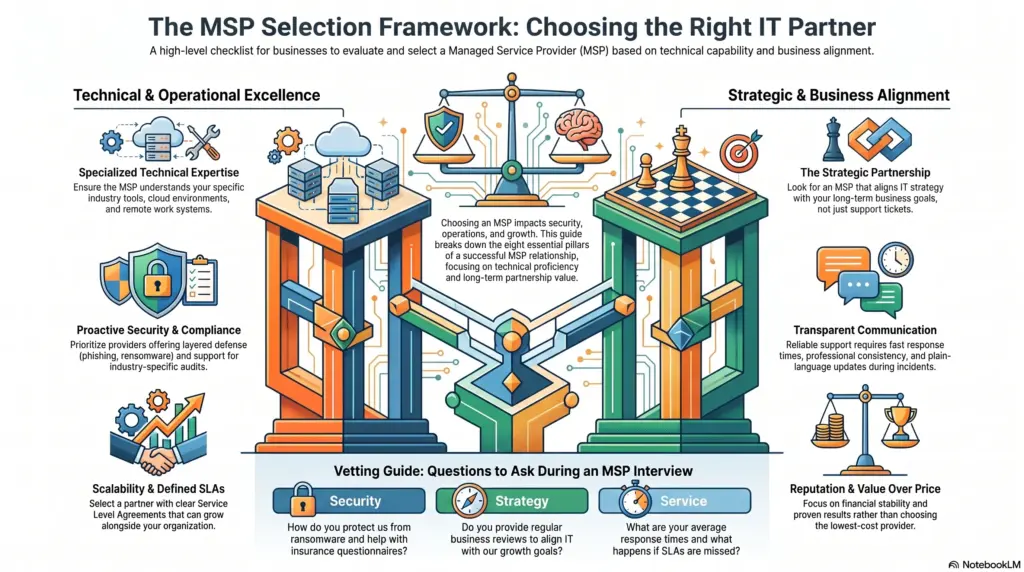
In this guide, we will cover the most important qualities to evaluate technical expertise and experience, security and compliance, service offerings and scalability, communication and support, service level agreements, strategic partnership, reputation and financial stability, and pricing and value.
1. Look for Technical Expertise and Real-World Experience
The first thing to look for in an MSP is technical expertise and experience. An MSP should have the knowledge and practical background to support the systems your business depends on every day.
That means they should understand your environment, your tools, and your industry requirements. A provider with broad experience is better equipped to solve problems quickly, recommend the right technologies, and prevent recurring issues.
Technical expertise also matters because technology environments are becoming more complex. Businesses now rely on cloud services, remote work tools, security platforms, backup systems, identity management, and collaboration tools. Your MSP should be comfortable managing all these moving parts.
Questions to ask:
- How long have you been supporting businesses like ours?
- What industries do you specialize in?
- What certifications or technical training does your team have?
- How do you stay current with technology changes?
A good MSP should be able to explain not just what it does, but why its experience makes it the right fit for your business.
2. Make Sure Your MSP Prioritizes Security and Compliance
Security and compliance should be among your top priorities when evaluating an MSP. Cyber threats continue to grow more advanced, and businesses of all sizes are being asked to prove they are managing data responsibly.
A strong MSP should help you reduce risk with layered security services such as endpoint protection, email security, phishing defense, vulnerability management, backup protection, monitoring, and incident response planning. It should also help you stay aligned with compliance requirements that may apply to your business.
Depending on your industry, that could include supporting audits, documentation, access controls, patch management, security awareness training, and retention policies.
Questions to ask:
- How do you protect us from ransomware, phishing, and other threats?
- What compliance frameworks or requirements do you support?
- Do you help with audits, insurance questionnaires, or security documentation?
- How do you monitor and respond to security issues?
An MSP that takes security seriously should be able to explain its process in clear, practical terms. You want a provider that does more than react after an incident. You want one that helps prevent incidents from happening in the first place.
3. Choose an MSP with Scalable Service Offerings
Every business has different needs, and those needs can change over time. That is why service offerings and scalability matter.
A good MSP should provide a range of services that fit your current needs while also being flexible enough to grow with your business. Some companies need help with desk support and workstation management. Others need backup and disaster recovery, cybersecurity, cloud support, strategic planning, or full IT management.
The right MSP should offer services that can scale as your organization expands, adds locations, hires employees, or adopts new technology.
Questions to ask:
- What services do you provide today?
- Can your services scale as our business grow?
- Do you offer co-managed IT or fully managed IT?
- How do you handle businesses with changing needs?
Scalability is important because your IT needs today may look very different a year from now. The best MSP should be able to support you through that growth without forcing you to switch providers.
4. Evaluate Communication and Customer Support
Communication is one of the most overlooked factors when choosing an MSP, but it is also one of the most important. Even the best technical team is not a good fit if they are hard to reach, slow to respond, or difficult to understand.
A strong MSP should communicate clearly and respond quickly when issues arise. It should also provide regular updates, explain problems in plain language, and keep your team informed about what is happening and why.
Support quality matters just as much as response time. You want a provider that is not only fast, but also helpful, professional, and consistent.
Questions to ask:
- How do you handle support requests?
- What are your average response and resolution times?
- How do you communicate during an outage or security incident?
- Who will be my main point of contact?
Strong communication builds trust. It helps reduce confusion, improves accountability, and makes the relationship much easier to manage.
5. Review the MSP’s Service Level Agreement
A service level agreement, or SLA, defines what kind of service you can expect from your MSP. This is an important part of the relationship because it sets clear expectations around response times, support availability, escalation processes, and service commitments.
Without an SLA, it can be difficult to know whether the MSP is meeting expectations. With a clear SLA, both sides understand what success looks like.
Questions to ask:
- What are your response time commitments?
- What is included in the SLA?
- How do you handle urgent or critical issues?
- What happens if service levels are not met?
A strong SLA should be realistic, measurable, and easy to understand. It should support your business needs and give you confidence that your provider is accountable.
6. Find an MSP That Acts as a Strategic Partner
A strategic MSP does more than respond to problems. It helps you make better decisions about technology, risk, growth, and efficiency. It understands your goals and recommends solutions that support your long-term success.
This kind of partnership is especially valuable when your business is planning major changes, such as expanding operations, improving cybersecurity, moving to the cloud, or preparing for audits and compliance reviews.
Questions to ask:
- How do you help customers plan for the future?
- Do you provide regular business reviews or technology planning sessions?
- How do you align IT strategy with business goals?
- How do you help us make smart technology investments?
A strategic partner should be invested in your success, not just in closing tickets. That means looking at the bigger picture and helping you build an IT environment that supports the future of your business.
7. Check the MSP’s Reputation and Financial Stability
Before choosing an MSP, take time to understand its reputation and financial stability. A provider may look good on paper, but you also want to know whether it has a track record of delivering reliable service.
Look for reviews, references, case studies, and long-term customer relationships. Ask how long they have been in business and whether they have experience supporting organizations like yours.
Financial stability also matters. You want an MSP that will be around for the long term and able to continue investing in its team, tools, and services.
Questions to ask:
- How long have you been in business?
- Can you provide references from current customers?
- What does customer retention look like?
- How do you invest in training and service quality?
A provider with a solid reputation and stable business foundation is more likely to give you consistent support over time.
8. Compare Pricing, Value, and Long-Term ROI
Price is always a factor, but it should not be the only factor. The cheapest MSP is not always the best choice, especially if it lacks experience, responsiveness, or strong security practices.
Instead of focusing only on cost, look at overall value. What are you getting for the price? What services are included? What risks are being reduced? What kind of support will your team receive?
A higher-priced MSP may still be the better value if it provides better service, stronger security, faster response times, and more strategic guidance.
Questions to ask:
- What is included in your pricing?
- Are there any hidden fees or additional charges?
- How do you compare value, not just price?
- What results should we expect from the investment?
The goal is not to find the cheapest provider. The goal is to find one that gives your business the right balance of service, protection, and value.
Questions to Ask Before Hiring an MSP
If you are still comparing providers, here are some of the most important questions to ask:
- What technical expertise and industry experience do you have?
- How do you protect us from cyber threats and compliance risks?
- What services do you offer, and can they scale with us?
- How do you communicate with customers and handle support?
- What does your SLA include?
- How do you act as a strategic partner?
- What is your reputation in the market?
- How do you structure pricing, and what value do we receive?
These questions will help you see beyond sales language and understand how the MSP operates.
But more importantly, they interpret the numbers. A dashboard is useful, but insight is better.
Customers want to know whether their MSP is improving their posture over time, not just logging activity.
Final Thoughts: Choosing the Best MSP for Your Business
If you are evaluating managed service providers, Accent Consulting can help you choose a partner that brings the right mix of technical expertise, security, scalability, and long-term value.
At Accent Consulting, we work with businesses that want more than basic IT support. We help organizations strengthen security, improve operations, and build a technology strategy that supports growth.
Visit accentconsulting.com to learn how we can help your business find the right MSP partner.
Reach Out To Us
Recent Posts
-
Recognized Among America’s Most Reliable Companies – 2026March 11, 2026/0 Comments -

What Makes an MSP Future-Ready in 2026?July 2, 2026/ -
Does Your Company Need an AI Policy?July 1, 2026/ -
-
Accent Consulting’s Summer Family Event 2026June 29, 2026/ -
-
-