Does Your Company Need an AI Policy? Here's why the Answer Is Yes

Published: July 1, 2026

Artificial intelligence is no longer a futuristic concept or a side project for IT teams. It is now embedded in everyday business operations — from drafting emails and analyzing data to automating workflows and supporting customer service. As AI adoption has accelerated, so have the risks. That is why more organizations are asking the same question: Do we need an AI policy?

The short answer is yes.

Whether your company is actively deploying AI tools or employees are already experimenting with generative AI on their own, an AI policy is quickly becoming essential. It provides guardrails for responsible use, helps protect sensitive information, supports compliance, and gives employees clarity about what is and is not allowed.

In 2026, the need for formal AI governance is even more urgent. Across industries, companies are responding to a growing number of AI-related regulations, vendor requirements, and internal risk concerns. New policy frameworks, disclosure requirements, and governance expectations are pushing businesses to define how AI should be used — and how it should not. Organizations that wait too long to create a policy often find themselves reacting to problems after they have already caused damage.

What Is an AI Policy?

An AI policy is a formal set of rules, expectations, and guardrails that govern how employees, contractors, and business units can use artificial intelligence tools and systems. It typically covers topics such as:

  • Approved AI tools and use cases
  • Confidentiality and data protection
  • Human review requirements
  • Accuracy and bias considerations
  • Intellectual property concerns
  • Compliance and legal obligations
  • Employee responsibilities
  • Escalation and reporting procedures

Think of an AI policy as the framework that helps your organization use AI safely, consistently, and strategically.

At Accent Consulting, our AI policy template is designed to help businesses start building that framework with a practical, easy-to-adapt structure. If your organization is looking for a foundation to work with, this template is a valuable starting point.

Why Every Business Needs an AI Policy

  1. AI use is already happening — with or without approval

Many companies assume that AI adoption is something they will plan for “later.” Employees are already using AI tools to summarize meetings, draft documents, generate code, create images, and accelerate research. Without a policy, that usage happens inconsistently and often without oversight.

This creates risk. Employees may unintentionally share confidential data with public tools, rely on inaccurate outputs, or violate company standards without realizing it. An AI policy helps bring those behaviors into the open and establish acceptable use.

  1. It protects sensitive data

One of the most important reasons to have an AI policy is data protection. AI tools often process user prompts and upload files, which can include customer information, internal documents, financial data, or proprietary business details. If employees input sensitive information into external AI tools without approval, the organization may face privacy, security, or contractual issues.

A good policy sets clear boundaries around what types of data can be used with AI and which tools are approved for specific levels of sensitivity.

  1. It reduces legal and compliance risk

AI regulation continues to evolve rapidly in 2026. Businesses are facing a more complex compliance environment that includes privacy laws, emerging AI governance requirements, industry-specific obligations, and vendor risk concerns. Even when formal laws do not explicitly name AI, existing obligations around confidentiality, recordkeeping, discrimination, and consumer protection still apply.

An AI policy helps organizations align AI use with legal and regulatory expectations, reducing the chance of misuse or noncompliance.

  1. It promotes accuracy and accountability

AI can be incredibly useful, but it is not always correct. It may hallucinate facts, misinterpret context, or generate biased outputs. If employees use AI-generated content without review, those errors can make their way into client deliverables, reports, marketing content, code, or internal decisions.

An AI policy should require human oversight for important outputs and make it clear that AI is a support tool, not a replacement for accountability.

  1. It supports brand and reputational protection

Your company’s reputation depends on the quality and consistency of the work you publish. If AI-generated content is inaccurate, misleading, biased, or off-brand, the consequences can be significant. A policy helps define review standards and usage expectations so that AI supports your brand instead of undermining it.

  1. It improves operational consistency

Without a policy, one department may use AI heavily while another avoids it entirely. Some teams may use approved enterprise tools, while others may rely on free public applications. That inconsistency creates confusion and risk.

A formal AI policy establishes shared standards across the organization, helping teams work more consistently and confidently.

  1. It prepares the business for future growth

AI will continue to evolve, and the organizations that succeed will be the ones that build governance early. An AI policy is not just about avoiding problems. It is also about creating a foundation for scalable innovation. With the right policy in place, companies can experiment, adopt new tools, and modernize workflows without losing control.
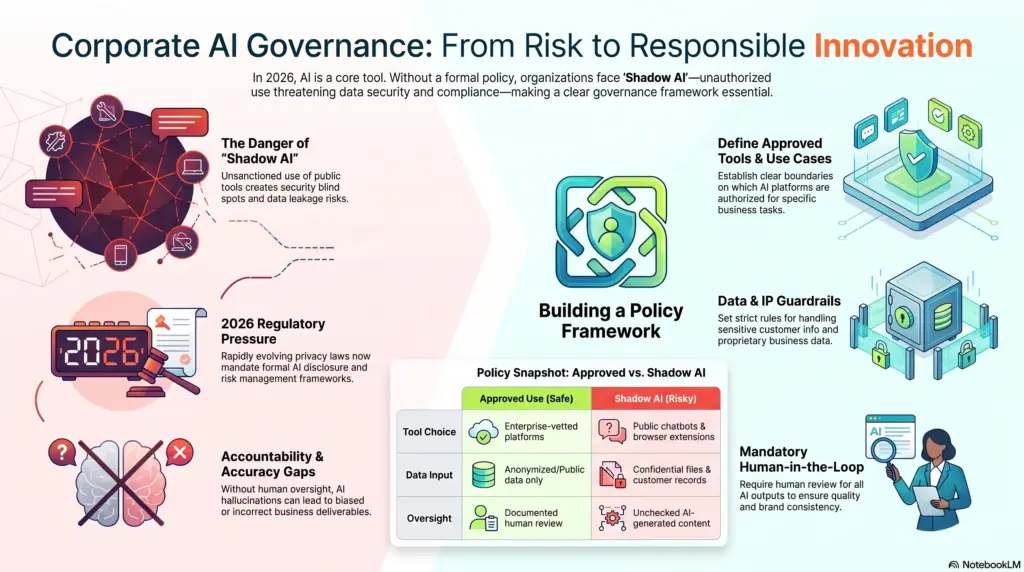
2026 AI Policy Trends Businesses Should Watch

In 2026, many organizations are seeing more pressure around AI governance from multiple directions:

  • Regulatory bodies are continuing to clarify expectations around transparency, risk management, and responsible AI use.
  • Customers and partners increasingly want assurance that their data is handled safely and that AI is being used responsibly.
  • Internal leadership teams want better visibility into where AI is being used and what risks it may introduce.
  • IT and security teams are dealing with a growing number of unauthorized AI tools entering the workplace.

The overall trend is clear: AI policy is moving from “nice to have” to “business essential.” Companies that establish policies now are better positioned to adapt as standards continue to mature.

What to Include in an Effective AI Policy

A strong AI policy does not need to be overly complicated, but it should address the basics clearly. At minimum, your policy should include:

  • Purpose and scope
  • Definitions of AI and generative AI
  • Approved and prohibited use cases
  • Data handling and confidentiality rules
  • Required human review and approval steps
  • Rules for customer-facing content
  • Intellectual property and copyright considerations
  • Security and vendor approval requirements
  • Training expectations
  • Incident reporting and escalation procedures
  • Enforcement and policy review schedule

Accent Consulting’s AI policy template can help organizations structure these elements in a practical way. If you are building your policy from scratch, using a template can save time and reduce the chance of overlooking critical issues.

Shadow AI: The Hidden Risk Your Business Can’t Ignore

One of the biggest reasons companies need an AI policy is the rise of shadow AI — the unsanctioned or unapproved use of AI tools by employees.

Shadow AI happens when employees use public AI platforms, browser extensions, chatbots, or automation tools without IT or leadership approval. Often, they are trying to be helpful, save time, or improve productivity. But even well-intentioned use can create serious risk.

As discussed in Accent Consulting’s blog, “What Is Shadow AI: Understanding the Business Risk of Unsanctioned AI Use,” shadow AI is not just an IT problem — it is a business risk.

Why Shadow AI Creates Serious Business Risk

  • Data leakage: Employees may paste confidential information into public tools.
  • Security blind spots: IT teams may not know which tools are being used or what data is leaving the organization.
  • Compliance violations: Unauthorized use may conflict with privacy, legal, or industry requirements.
  • Inconsistent output: Different teams may use different tools with no standards for accuracy or review.
  • Vendor risk: Unvetted AI tools may store data insecurely or reuse it in ways the business did not intend.

Shadow AI is often a symptom of a bigger issue: employees want AI capabilities, but the organization has not provided clear guidance or approved alternatives. A strong AI policy helps reduce shadow AI by defining acceptable use and giving employees a safe path forward.

Common Challenges When Implementing an AI Policy

Creating an AI policy is one thing. Implementing it successfully is another. Companies often face several challenges:

  1. Keeping pace with rapidly changing technology

AI tools evolve quickly. A policy written today may feel outdated within months if it is too rigid. Businesses need policies that are clear but flexible enough to adapt as technology changes.

  1. Balancing innovation and control

If a policy is too restrictive, employees may avoid useful tools or work around the rules. If it is too loose, it fails to protect the business. The goal is to create boundaries that encourage responsible experimentation.

  1. Achieving employee buy-in

A policy only works if people understand it and follow it. Employees are more likely to comply when leadership explains the reasons behind the policy and provides approved tools and training.

  1. Identifying all AI use cases

AI may already be used in marketing, sales, HR, finance, customer service, software development, and operations. Companies often underestimate how widespread AI use has become, which makes policy rollout more difficult.

  1. Determining ownership

AI governance often spans multiple departments, including IT, legal, compliance, HR, operations, and leadership. Without clear ownership, policies can become inconsistent or unenforced.

How to Keep Your AI Policy Useful Over Time

An AI policy should be treated as a living document, not a one-time exercise. Here are some practical tips for keeping it effective:

  1. Review it regularly

Set a recurring review cycle, such as every six or twelve months, to make sure the policy still reflects current tools, risks, and regulations.

  1. Train employees consistently

Do not assume people will read the policy once and remember it forever. Include AI policy training in onboarding, annual compliance education, and manager briefings.

  1. Keep approved tools updated

Maintain a clear list of approved AI tools and make it easy for employees to know what they can use. If tools are added or removed, communicate those changes quickly.

  1. Create a simple reporting process

Employees should know where to go if they discover questionable AI use, unsafe prompts, or an error in AI-generated content.

  1. Monitor usage patterns

Where possible, watch for signs of shadow AI and unauthorized tool adoption. This is not about surveillance — it is about visibility and risk management.

  1. Involve multiple stakeholders

A good AI policy should be informed by IT, legal, HR, and business leaders. Cross-functional input makes the policy more realistic and more likely to be followed.

  1. Make the policy practical

The best policies are easy to understand and apply in daily work. Avoid jargon where possible and include examples of acceptable and unacceptable use.

Final Thoughts: Don’t Wait to Create Your AI Policy

If your company is asking whether it needs an AI policy, the answer is yes — and the right time to create one is now. AI is already reshaping the way businesses operate, and the risks associated with ungoverned use are only increasing. A clear policy helps protect data, reduce legal exposure, improve consistency, and support responsible innovation.

If you are ready to get started, Accent Consulting’s AI policy template at is a strong resource for building a policy that fits your organization. And if you want to better understand the risks of unsanctioned AI use, read our blog on shadow AI: “What Is Shadow AI: Understanding the Business Risk of Unsanctioned AI Use.”

In a world where AI is becoming part of everyday business, the question is no longer whether you should have an AI policy. The real question is: how long can your business afford to go without one?

In a world where AI is becoming part of everyday business, the question is no longer whether you should have an AI policy. The real question is: how long can your business afford to go without one?

Need help creating or refining your AI policy? Accent Consulting can help your organization turn AI governance into a practical, business-ready framework. Contact Accent Consulting today to discuss your goals, assess your risks, and take the next step toward responsible AI adoption.

Reach Out To Us

Recent Posts