

What Makes an MSP Future-Ready in 2026?
Published: July 2, 2026
The managed services landscape is changing quickly. In 2026, customers are no longer looking for an MSP that simply keeps the lights on. They want a strategic partner that helps them stay secure, resilient, compliant, and prepared for what comes next.
That shift is being driven by several major realities: cyber threats are becoming more advanced, compliance expectations are increasing, AI is changing how businesses operate, and downtime is more costly than ever. The MSPs that stand out in 2026 will move beyond break-fix support and operate as trusted advisors with a future-ready service model.
So, what does “future-ready” actually mean? And what should customers be asking when evaluating an MSP?
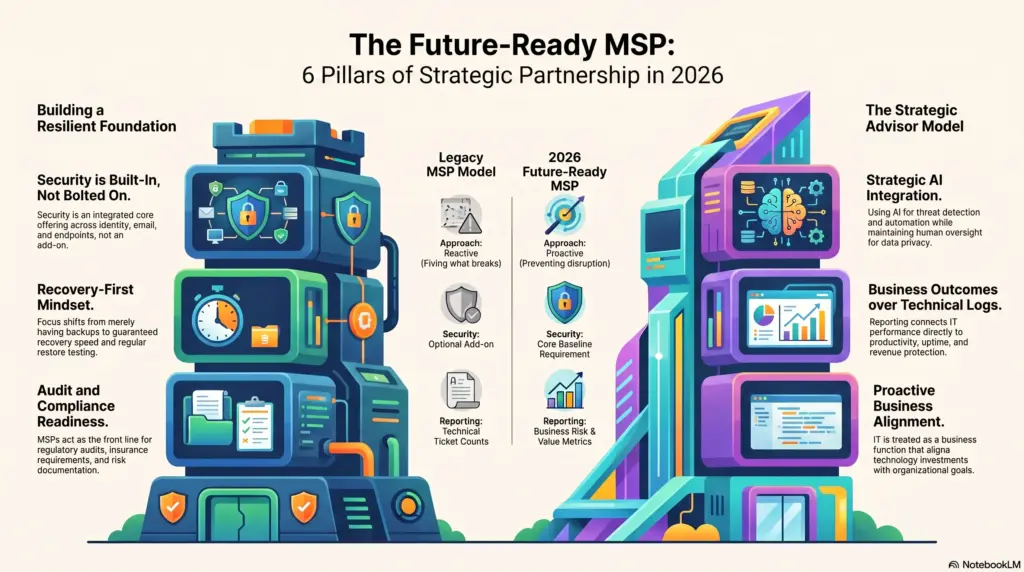
In short, a future-ready MSP is defined by how well it protects the business, prepares it for disruption, and communicates value in clear business terms.
1. Security Is Built In, Not Bolted On
In 2026, security is not a separate add-on. It is part of every modern MSP offering.
A future-ready MSP does more than install antivirus software and monitor alerts. It provides layered security across endpoints, email, identity, backups, user training, and incident response. Common capabilities include:
- Managed endpoint security
- Advanced email security
- Phishing and social engineering protection
- Dark web monitoring
- Breach notification support
- Vulnerability management
- Incident response planning
Customers should ask:
- How do you reduce risk before a breach happens?
- What happens if an employee clicks a phishing link?
- How quickly can you detect and respond to a threat?
If an MSP cannot clearly answer those questions, they may still be operating in an older service model.
2. The MSP Prepares Customers for Recovery, Not Just Prevention
One of the biggest lessons from recent years is that no environment is completely immune to disruption. Ransomware, accidental deletion, cloud service failures, and human error can all take systems offline.
That’s why future-ready MSPs treat backup and recovery as core business services, not just technical insurance.
Customers expect an MSP to provide:
- Backup monitoring and maintenance
- Regular restore testing
- Disaster recovery planning
- Cloud and on-prem recovery support
- Clear recovery time and recovery point expectations
- Documentation for critical systems and processes
A future-ready MSP should be able to answer:
- How long would it take to recover our most critical systems?
- When was the last restore test performed?
- What happens if our cloud provider has an outage?
In 2026, recovery readiness is a major differentiator. Businesses want confidence that they can get back to work quickly after an incident, not just reassurance that backups exist somewhere.
3. AI Is Used Carefully and Strategically
AI is now part of nearly every business conversation, and customers expect their MSP to have a point of view. But “using AI” is not enough. A future-ready MSP knows where AI adds value and where it creates risk.
Smart MSPs use AI to improve:
- Ticket triage
- Alert correlation
- Knowledge retrieval
- Threat detection
- Reporting efficiency
- Repetitive workflow automation
But they also understand the risks around privacy, hallucinations, data leakage, and overreliance on automation.
Customers want to know:
- How are you using AI in your delivery service?
- What customer data is exposed to AI tools?
- How do you verify AI-generated recommendations?
The best MSPs will be transparent. They will explain where AI helps them respond faster and where human expertise still matters most. That kind of clarity builds trust.
4. Visibility Goes Beyond Tickets
A future-ready MSP does not just close tickets. It gives customers visibility into the health of their environment and the value of the services being delivered.
That means regular reporting and executive-level summaries that answer questions like:
- What security threats were blocked this month?
- What systems are at risk?
- Where are we improving?
- What needs attention next?
- How are we reducing operational risk?
Many customers do not want raw technical logs. They want clear business language. They want to understand how the MSP is protecting productivity, uptime and revenue.
A strong MSP should provide reporting that connects IT performance to business outcomes.
That is where things like technology reports, executive summaries, annual risk assessments, and threat intelligence reviews become valuable. These are not just nice extras. They are proof that the MSP is operating as a strategic partner.
5. Compliance and Audit Readiness Are Part of the Service
Regulatory pressure continues to rise across industries. Whether a business is responding to cybersecurity requirements, insurance questionnaires, privacy rules, or client-driven security demands, the MSP is often on the front line of compliance support.
A future-ready MSP helps customers stay audit-ready by supporting:
- Policy and process documentation
- Risk assessments
- Access reviews
- Security awareness training
- Patch and update management
- Logging and monitoring
- Backup and retention practices
- Incident response preparation
The right MSP should be able to speak the language of risk, not just the language of systems.
Customers should ask:
- Can you help us prepare for audits or insurance reviews?
- Do you provide documentation we can use internally?
- How do you help us reduce compliance gaps over time?
In 2026, compliance is not just about passing a test. It is about proving that the business is responsibly managing technology and information.
6. Support Is Proactive, Not Reactive
The old MSP model often revolved around reacting to problems. A future-ready MSP is proactive.
That means identifying issues before they cause disruption. It includes patching systems, monitoring endpoints, reviewing alerts, analyzing risks, and meeting with customers regularly to keep environments healthy.
Proactive support can include:
- Patch maintenance
- OS and driver updates
- Application support
- Printer and workstation management
- Continuous monitoring
- Alert remediation
- Security reviews
- Quarterly business reviews
The goal is not just to fix issues quickly. It is to reduce the number of issues in the first place.
Customers should ask:
- What do you do proactively every month?
- How do you identify trends before they become problems?
- What does success look like after 90 days, six months, and one year?
The more proactive the service model, the more strategic the MSP becomes.
7. IT Is Treated as a Business Function
By 2026, customers expect their MSP to understand business priorities, not just technical systems.
A future-ready MSP knows that uptime matters because employees need to serve customers. It knows that email security matters because phishing leads to fraud. It knows that backup matters because downtime affects revenue. It knows that endpoint protection matters because one compromised device can create a major incident.
This mindset changes how the MSP communicates. Instead of saying, “We installed a control,” the MSP says, “We reduced risk to your business.” Instead of saying, “The ticket is closed,” the MSP says, “Your team can work securely and efficiently.”
Customers should ask:
- How do you align IT priorities with business goals?
- Can you explain risk in terms of business impact?
- How do you help us make smarter decisions about technology investments?
The future-ready MSP is not just an IT vendor. It is a business enabler.
8. Incident Response Is Clear and Documented
When something goes wrong, customers want to know who is in charge, what happens next, and how communication works.
That is why incident response is a major marker of MSP maturity.
A future-ready MSP should have:
- A documented incident response process
- Escalation paths
- Communication templates
- Defined roles and responsibilities
- Coordination with vendors and third parties
- A plan for cyber crises and service outages
Customers should ask:
- If we have a security incident, what happens in the first hour?
- Who do we contact?
- How do you communicate updates?
- How do you help us recover and document the event?
9. Outcomes Are Measurable
Future-ready MSPs do not ask customers to trust them blindly. They measure outcomes.
That means tracking metrics such as:
- Response times
- Resolution times
- Patch compliance
- Backup success rates
- Restore test success
- Phishing resilience
- Security event counts
- Risk reduction progress
But more importantly, they interpret the numbers. A dashboard is useful, but insight is better.
Customers want to know whether their MSP is improving their posture over time, not just logging activity.
10. The MSP Is Easy to Work With
In 2026, customers still care about the basics: responsiveness, clarity, and consistency.
A future-ready MSP is technologically advanced, but also easy to do business with. That includes:
- Clear communication
- Fast and helpful support
- Well-defined service scope
- Transparent pricing
- Practical recommendations
- Helpful documentation
- Regular check-ins
Customers often leave MSPs not because of one bad issue, but because the relationship feels hard, reactive, or unclear.
The best MSPs combine strong technical capability with excellent client experience.
Questions Customers Should Ask an MSP in 2026
If you want to evaluate whether an MSP is future-ready, ask these questions:
- How do you approach security across endpoints, email, users, and backups?
- What is your process for phishing and ransomware protection?
- How do you support recovery if systems go down?
- Do you perform restore tests and disaster recovery reviews?
- How do you use AI in your service delivery?
- What do your reports tell us beyond ticket counts?
- How do you help us with compliance and audit readiness?
- What proactive services do you provide every month?
- How do you handle incident responses?
- How do you measure business value?
The answers will tell you a lot about whether the MSP is truly future-ready or just using the right language.
Final Thoughts
If you want to evaluate whether an MSP is future-ready, ask these questions:
- How do you approach security across endpoints, email, users, and backups?
- What is your process for phishing and ransomware protection?
- How do you support recovery if systems go down?
- Do you perform restore tests and disaster recovery reviews?
- How do you use AI in your service delivery?
- What do your reports tell us beyond ticket counts?
- How do you help us with compliance and audit readiness?
- What proactive services do you provide every month?
- How do you handle incident responses?
- How do you measure business value?
The answers will tell you a lot about whether the MSP is truly future-ready or just using the right language.
Reach Out To Us
Recent Posts
-
Recognized Among America’s Most Reliable Companies – 2026March 11, 2026/0 Comments -

What Should You Look for in an MSP?July 2, 2026/ -
Does Your Company Need an AI Policy?July 1, 2026/ -
-
Accent Consulting’s Summer Family Event 2026June 29, 2026/ -
-
-