
AI for Business: How to Get Started with AI Literacy as a Business Leader

Published: July 1, 2026

Artificial intelligence (AI) is transforming the way companies operate, compete, and grow. From automating routine tasks to improving customer experience and supporting better decision-making, AI for business is no longer a future trend — it is a present-day advantage. Yet many organizations still struggle with a common challenge: how to get started with AI in a way that is practical, responsible, and aligned with business goals.

For business leaders, the answer begins with AI literacy. Understanding what AI is, how it works, and how to apply it strategically is now an essential leadership skill. In a business environment where digital transformation, data-driven decision making, and automation are becoming standard, leaders who build AI literacy can identify opportunities faster, reduce risk, and make smarter investments.

What is AI for Business

AI for business refers to the use of artificial intelligence tools and systems to improve business operations, decision-making, customer engagement and innovation. AI can be used across nearly every function, including marketing, sales, customer service, human resources, operations, finance and supply chain management.

Common examples of AI in business include:


• Chatbots and virtual assistants for customer support
• Predictive analytics for sales forecasting
• AI-powered personalization in marketing
• Fraud detection in financial services
• Automated scheduling and workflow management
• Document analysis and data processing

The value of AI for business lies in its ability to analyze large amounts of data quickly, identify patterns and perform tasks that would otherwise require significant time and human effort.

What is AI Literacy?

To build AI literacy in business, leaders should understand several key components:

  1. Understanding AI basics

Leaders should know the difference between AI, machine learning, generative AI and automation. These terms are often used interchangeably, but they are not the same.

  1. Data awareness

AI depends on data. Business leaders need to understand what data is being used, where it comes from and whether it is accurate, secure and compliant.

  1. Model limitations

AI systems are powerful, but they are not perfect. They can produce errors, reflect bias, or make poor predictions if the data is flawed or incomplete.

  1. Ethical and responsible use

AI can raise issues around privacy, fairness, transparency and accountability. Leaders should understand these concerns before deployment.

  1. Business alignment

AI should support business strategy, not distract from it. AI literacy includes knowing how to evaluate whether a tool solves a real business problem.

How to Use AI for Business

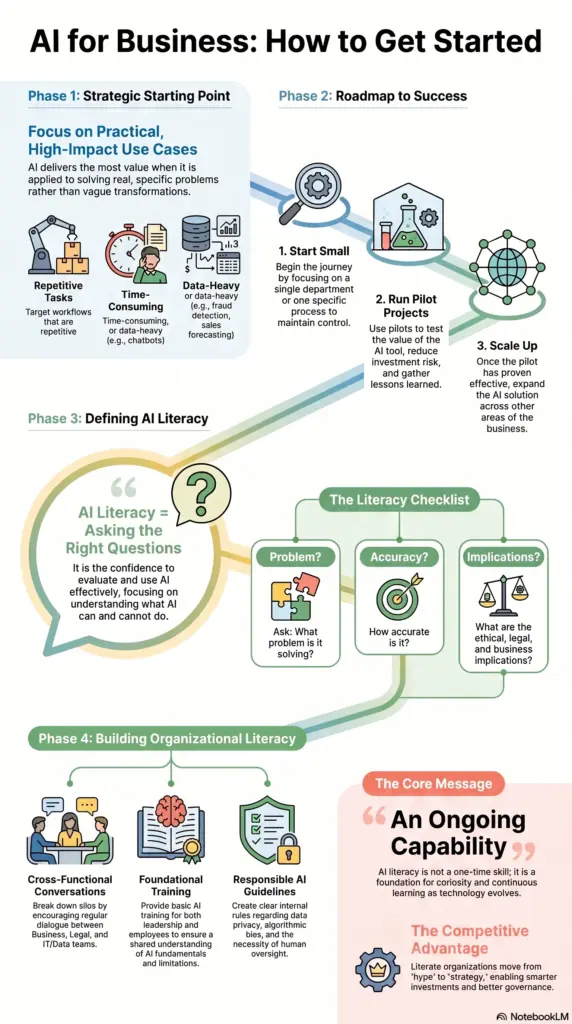
The best way to get started with AI is to focus on practical, high-value use cases. Rather than adopting AI for the sake of innovation, businesses should identify areas where AI can improve efficiency, reduce cost or create better customer experiences.

Here are a few practical ways to use AI for business:


Improve customer service
AI chatbots and virtual assistants can handle routine customer questions 24/7, freeing up staff to focus on more complex issues. This improves response times and customer satisfaction.


Enhance marketing
AI can help businesses analyze customer behavior, segment audiences, personalize content and optimize campaigns. This makes marketing more targeted and effective.


Support sales
Predictive AI tools can identify leads most likely to convert, helping sales teams prioritize their efforts and improve revenue performance.


Streamline operations
AI can automate repetitive tasks such as data entry, scheduling, document classification and inventory tracking. This increases productivity and reduces manual errors.


Strengthen financial decision-making
AI can help detect anomalies, forecast trends and improve risk management. In finance, speed and accuracy are especially valuable.

Why AI Literacy Is Important for Business Leaders

AI literacy is important because leaders are increasingly making decisions in an AI-enabled environment. Without a solid understanding of AI, leaders may:


• Invest in tools that do not solve real problems
• Overestimate what AI can deliver
• Overlook legal, ethical, or security risks
• Fail to prepare employees for new workflows
• Miss opportunities to gain a competitive edge

By contrast, AI-literate leaders are better equipped to guide AI adoption, build trust and create a roadmap for long-term success. They can align AI initiatives with business strategy, support change management and ensure responsible use.

In short, AI literacy for business leaders is not optional — it is becoming a core leadership competency.

How Businesses Can Improve AI Literacy

Businesses can improve AI literacy through a combination of education, culture and hands-on experience.

1. Offer AI training

Provide workshops, webinars and training sessions for executives, managers and employees. Training should cover AI basics, use cases, risks and opportunities.


2. Start with practical use cases
The best way to learn AI is by using it. Begin with pilot projects that solve real problems and produce measurable results.


3. Encourage cross-functional collaboration
AI should not sit only with IT or data teams. Business leaders, legal teams, HR, operations and compliance should all be involved.


4. Create AI governance policies
Set clear rules for AI use, including data handling, security, transparency and human oversight. Governance builds trust and consistency.


5. Promote continuous learning
AI is evolving quickly. Businesses should make AI literacy part of an ongoing learning culture, not a one-time initiative.

Practical Importance of AI in Business

The practical importance of AI is clear: it helps businesses work smarter. AI can improve productivity, reduce costs, speed up decisions and increase customer satisfaction. It can also help teams focus on higher-value work by taking over repetitive or time-consuming tasks.

For small businesses, AI can provide access to capabilities that once required large teams or expensive systems. For larger organizations, AI can help scale operations, improve forecasting and uncover insights across complex data environments.

In a competitive market, businesses that use AI effectively are often more agile, more efficient and better prepared for change.

Broader Implications of AI for Business

The broader implications of AI go beyond efficiency and profit. AI is reshaping how businesses hire, serve customers, manage data and make decisions. It is also changing the skills employees need to succeed.

This means leaders must think beyond implementation and consider the wider impact of AI on their organization and society. Questions of bias, privacy, transparency and job redesign matter. Businesses that approach AI responsibly can build stronger trust with employees, customers and stakeholders.

AI also has strategic implications. Companies that build AI literacy now will be better prepared for future innovation, regulatory changes and market disruption. In many industries, AI will increasingly separate businesses that adapt from those that fall behind.

Practical Importance of AI in Business

The practical importance of AI is clear: it helps businesses work smarter. AI can improve productivity, reduce costs, speed up decisions and increase customer satisfaction. It can also help teams focus on higher-value work by taking over repetitive or time-consuming tasks.

For small businesses, AI can provide access to capabilities that once required large teams or expensive systems. For larger organizations, AI can help scale operations, improve forecasting and uncover insights across complex data environments.

In a competitive market, businesses that use AI effectively are often more agile, more efficient and better prepared for change.

Final Thoughts

Getting started with AI for business does not require a massive transformation on day one. It starts with understanding the technology, identifying real business problems and building AI literacy at the leadership level. Businesses that invest in AI literacy will be better positioned to use AI responsibly, make stronger decisions and create lasting value.

The future of business is not just about using AI — it is about understanding it well enough to lead with confidence.

Ready to build AI literacy in your organization? Contact Accent Consulting to explore practical AI strategies, training and implementation support for your business. Visit accentconsulting.com to get started.

Reach Out To Us

Recent Posts