
MANUFACTURING CYBERSECURITY BENCHMARKING
The Benchmark Advantage:
How Your Manufacturing Cyber Risk Compares
Across 21 manufacturers, the data shows a clear performance gap between average and best-in-class cybersecurity.
Cybersecurity risk looks different when you have something to compare it to.
A security finding on its own tells you something is wrong. A benchmark helps tell you how much it matters.
Using cybersecurity assessment data from 21 manufacturers, we compared the concentration of high-risk findings across organizations to understand how performance differs — and what separates manufacturers carrying significantly less risk from the rest.
The goal isn’t to create an industry scorecard. It’s to provide context. By seeing where risk concentrates, how widely performance varies and which practices are associated with stronger results, manufacturers can make better decisions about what deserves attention first.
21
Manufacturers
Benchmarked
10.6
Average High-Risk
Issues
2
Lowest High-Risk
Count
19
Highest High-Risk
Count
WHERE MANUFACUTERS DIFFER
What best-in-class manufacturing cybersecurity looks like.
Across the 21 manufacturers in this benchmark, the average company had 10.6 high-risk issues — but that average hides a more important truth: manufacturers do not all carry risk the same way. The strongest performer had only 2 high-risk issues, while the highest-risk manufacturer had 19, showing that better outcomes already exist and the performance gap is substantial.
Best-in-class manufacturing cybersecurity is not about perfection. It is about control. The organizations that perform better tend to identify risk earlier, focus on the most important gaps, and act before issues become normalized.
Two priorities stood out most clearly: identity governance and patch management. Together, those fundamentals helped the top performer achieve 80% fewer vulnerabilities than average, reinforcing one of the clearest lessons from the data: stronger performance often comes from covering the basics consistently well.
COMMON ACCESS AND CONTROL GAPS
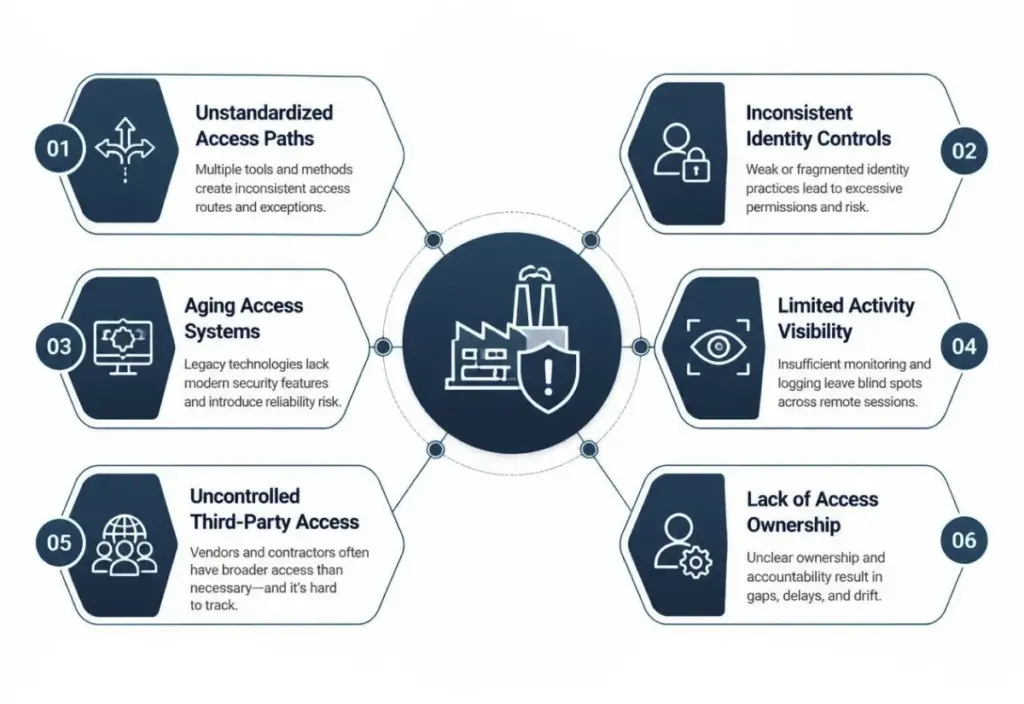
Six access issues that increase manufacturing cyber-risk.
The benchmark shows that better cybersecurity performance is often driven by stronger control over foundational risks. In manufacturing environments, those risks frequently appear in the form of recurring access and governance gaps that are difficult to detect until they begin affecting visibility, accountability, or operational stability.
This graphic highlights six of the most common issues: unstandardized access paths, inconsistent identity controls, aging access systems, limited activity visibility, uncontrolled third-party access, and lack of access ownership. Together, these gaps can expand exposure, slow response, and make it harder to manage cyber risk consistently across the environment.
Understanding where these issues exist is a critical step in building a stronger baseline, prioritizing improvements and reducing long-term risk. It also helps leaders focus resources where they can have the greatest operational and security impact across systems, teams and business priorities.
FOUNDATIONAL BEST PRACTICES
Where manufacturers should start to reduce cyber risk.
The benchmark points to a practical answer: the manufacturers that perform best are not necessarily the ones doing the most. Rather, they are often the ones doing the fundamentals earlier and more consistently. That means stronger visibility, clearer ownership and more disciplined follow-through on the controls that reduce everyday exposure. Over time, that consistency creates a more stable security foundation and makes improvement easier to sustain.
That starts with understanding your current environment before comparing it to others. A baseline assessment gives manufacturing leaders the context needed to identify major gaps, prioritize the right actions and measure progress over time.
These are foundational moves, but in manufacturing environments, such discipline is often what creates the biggest long-term difference. It helps reduce recurring exposure before it becomes a larger operational problem and gives leaders a more reliable approach for building resilience over time. Just as importantly, it makes future security decisions easier to prioritize and defend.
WHAT STRONGER PERFORMERS PRIORITIZE
How should manufacturers prioritize cybersecurity improvements?
Manufacturers rarely struggle to find issues. They struggle to decide which ones deserve action first.
Benchmarking improves prioritization because it adds proportion. It helps leaders see which categories are creating the largest performance gap relative to peers and where focused action is likely to reduce the most exposure.
A practical prioritization process looks like this:
- Establish a baseline assessment
- Compare results to peer benchmarks
- Identify the largest risk gaps
- Focus on foundational categories first
- Reassess over time to track measurable improvement
This is one of the biggest advantages of benchmark data. It turns cybersecurity from a list of disconnected tasks into a sequence of business decisions.

TURN INSIGHTS INTO ACTON
What You Can Do Next
What does the benchmark say about manufacturing cyber-risk?
Across the benchmark, a clear pattern emerges: manufacturers are not all carrying cyber risk the same way. The same issue categories appear across many environments, but the gap between average and stronger performers is significant. What separates them is not usually size or complexity. It is how early foundational risks are identified, prioritized and addressed.
What Is a manufacturing cybersecurity benchmark?
A manufacturing cybersecurity benchmark compares one organization’s security findings to peer manufacturers in the same sector. It helps leaders understand whether their current level of risk is typical, elevated or stronger than average.
Why does cybersecurity benchmarking matter for manufacturers?
Across the 21 manufacturers assessed, the average organization carried 10.6 high-risk issues. The strongest performer had 2 and the highest-risk manufacturer had 19. That spread shows that cyber risk is not evenly distributed across the sector.
How should manufacturers use the benchmark data?
Benchmark data is most useful when it improves prioritization. Manufacturers should establish a baseline, compare results to peers, identify the biggest gaps and focus first on foundational issues that reduce exposure most effectively.
What does this mean for manufacturing leaders?
Most manufacturers do not struggle because they are unaware of cyber risk. They struggle because they lack context. Benchmarking helps leaders understand where they stand, what good performance looks like and what to do next.
WHAT YOU CAN DO NEXT
Build a clearer cybersecurity roadmap.
Use benchmark data to understand your current exposure, prioritize high-impact gaps